Table of contents
Overview
In today’s global digital landscape, localization tools play a crucial role in helping businesses adapt their content for diverse audiences. These tools go beyond simple translation by modifying language, visuals, and cultural elements to ensure better engagement and understanding. However, most SCORM localization tools require you to rebuild your course inside their own authoring system. Doctor eLearning works differently — it translates your Articulate DOCX or XLIFF export into 130+ languages, then compresses the final SCORM package for faster LMS delivery. No need to reopen Storyline, Rise, or Captivate. By using advanced localization tools, businesses can expand globally, improve learner experience, and deliver content that truly resonates across different regions.
What Are Localization Tools and Why Do You Need Them?
Before diving into the “how,” it’s important to understand what makes global content adaptation seamless. Localization tools are specialized software designed to help businesses adapt their content for different languages, regions, and cultures. Unlike basic translation tools, they ensure that text, visuals, formatting, and functionality remain intact across different versions of content.
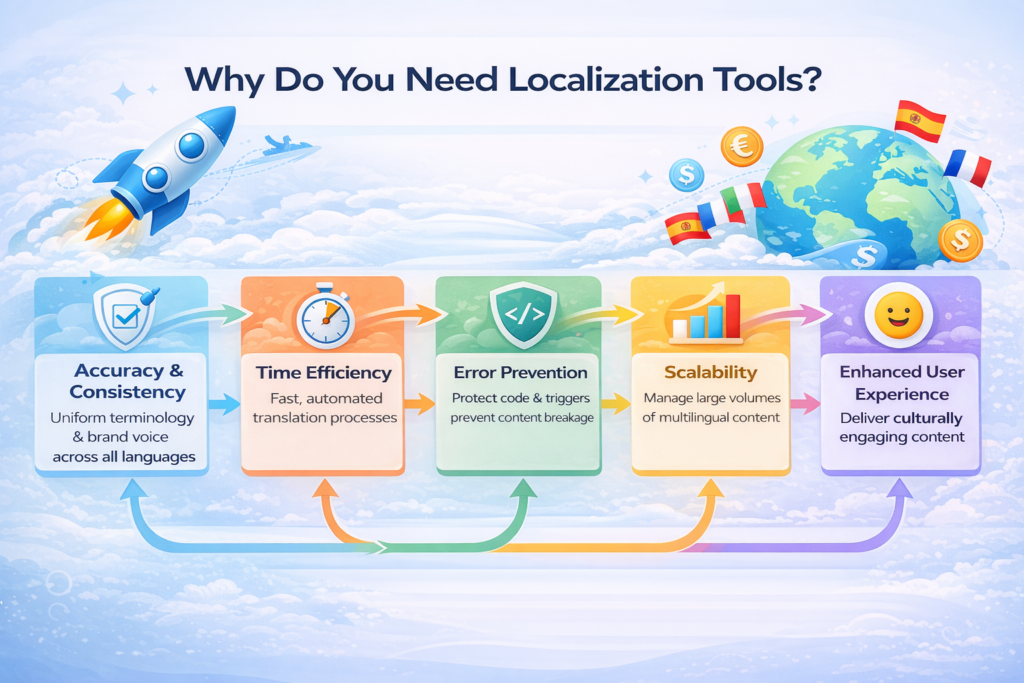
Why Do You Need Localization Tools?
As businesses expand globally, relying on manual translation is no longer efficient or scalable. Instead, localization tools provide the structure and automation needed to deliver consistent, high-quality content across multiple regions.
Key Features of Modern Localization Platforms
| Feature | Description | Tools That Offer This Feature | Why It Matters |
|---|---|---|---|
| Translation Management System (TMS) | Centralized platform to manage multilingual content and workflows | Doctor eLearning | Keeps all translations organized in one place for better control |
| AI & Machine Translation Integration | Uses AI engines for fast and automated translations | Doctor eLearning, Smartcat | Reduces manual effort and speeds up localization workflows |
| XLIFF & File Format Support | Supports formats like XLIFF, SCORM, HTML, DOCX | Doctor eLearning, Lokalise | Prevents breaking code and maintains structure |
| In-Context Editing | Allows editing directly within the content layout preview | Doctor eLearning | Avoids UI issues like text overflow and misalignment |
| Automation & Workflow Management | Automates file handling, approvals, and updates | Doctor eLearning, Phrase | Saves time and improves efficiency |
| Glossary & Translation Memory | Stores repeated terms for consistency | Doctor eLearning, Smartcat, Lokalise | Maintains brand voice across languages |
| Collaboration Tools | Enables teamwork between translators and developers | Doctor eLearning | Improves communication and reduces errors |
| Quality Assurance (QA) Checks | Detects translation errors and formatting issues | Doctor eLearning, Crowdin | Ensures high-quality and accurate output |
| Scalability | Handles large multilingual projects efficiently | Doctor eLearning, Lokalise | Supports global business expansion |
| Multimedia Localization Support | Supports translation of videos, audio, and images | Doctor eLearning, Smartcat | Essential for eLearning and rich content |
Benefits of Using Localization Tools vs Manual Translation
| Aspect | Localization Tools (e.g., Doctor eLearning, Smartling, Phrase) | Manual Translation |
|---|---|---|
| Speed | Fast and automated workflows (Doctor eLearning simplifies SCORM and eLearning translation quickly) | Slow process as everything is done manually |
| Accuracy | High accuracy with AI + translation memory (Doctor eLearning ensures precise eLearning translations) | Depends on individual translators, may vary |
| Consistency | Maintains uniform terminology using glossaries and memory tools | Inconsistencies likely across large projects |
| Error Prevention | Protects code, formatting, and triggers (Doctor eLearning prevents broken course errors) | High risk of breaking code or formatting |
| Scalability | Easily handles large multilingual projects (Doctor eLearning supports bulk course localization) | Difficult to manage as project size increases |
| Collaboration | Centralized platform for teams (Doctor eLearning allows smooth workflow management) | Communication is scattered and inefficient |
| Cost Efficiency | Reduces long-term cost by reusing translations | Higher cost due to repeated manual work |
| Best Use Case | Ideal for global businesses and eLearning localization (Doctor eLearning is best for SCORM-based courses) | Suitable for small, one-time projects |
Top Localization Tools Reviewed
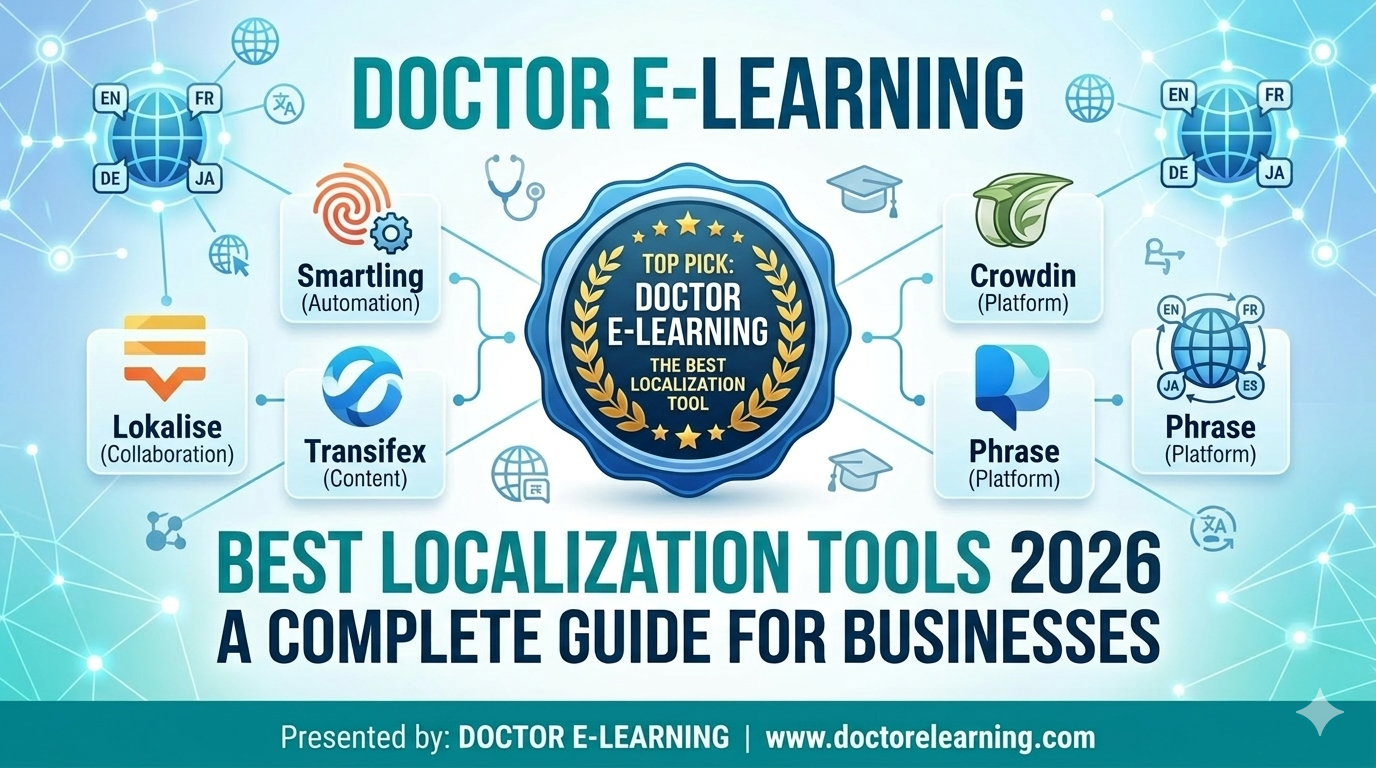
Below is our curated list of the top localization tools in 2026, designed to help businesses manage multilingual content efficiently. These platforms offer a mix of automation, collaboration, and advanced translation capabilities—but one clear leader stands out for eLearning professionals.
1. Doctor eLearning (The Industry Leader)
Doctor eLearning has established itself as a top-tier solution, especially for eLearning localization. Unlike generic translation tools, it is specifically built to handle SCORM courses and complex eLearning files.
- Why it stands out: It offers a powerful “what you see is what you get” interface, allowing users to preview translations directly within the course layout.
- Key Advantage: Advanced tag protection ensures that variables, triggers, and formatting remain intact—eliminating common technical errors.
- Best For: eLearning developers, instructional designers, and L&D teams.
2. Smartling
Smartling is a cloud-based localization platform known for its enterprise-grade automation and analytics.
- Key Features: AI-powered translation, workflow automation, real-time reporting
- Best For: Large enterprises managing high-volume content
3. Phrase
Phrase is a popular localization management platform offering flexible integrations and developer-friendly tools.
- Key Features: Translation memory, API integrations, automation workflows
- Best For: Tech companies and agile teams
4. Lokalise
Lokalise provides a collaborative environment for managing translations with strong in-context editing features.
- Key Features: Real-time collaboration, UI previews, automation
- Best For: Startups and product teams
5. Crowdin
Crowdin is widely used for software and app localization, supporting continuous localization workflows.
- Key Features: Git integration, automation, team collaboration
- Best For: Developers and software teams
6. Transifex
Transifex focuses on continuous localization and AI-driven translation workflows.
- Key Features: Cloud-based system, automation, scalability
- Best For: SaaS platforms and digital products
7. Smartcat
Smartcat combines translation, automation, and freelancer marketplace features in one platform.
- Key Features: AI translation, collaboration tools, vendor management
- Best For: Businesses needing both tools and translators
Smartling, Phrase, Lokalise, Crowdin, Transifex, and Smartcat are capable general-purpose localization platforms — strong for software, apps, and web content. None, however, are built specifically for eLearning formats, meaning SCORM, Articulate DOCX, and XLIFF files typically need manual handling or extra plugins to work properly.
How to Choose the Right Localization Tool
Selecting the right localization tools is crucial for ensuring smooth global expansion and delivering high-quality multilingual content. Businesses should evaluate tools based on their ability to integrate with existing workflows, support multiple content formats, and maintain translation accuracy. Particularly for industries like eLearning, where technical structure and user experience are critical, choosing a specialized solution like Doctor eLearning can make a significant difference. Unlike generic tools, Doctor eLearning works directly with the published output — no source files required. This ensures that even complex courses remain fully functional after localization, avoiding common issues like broken layouts or lost interactivity.
Essential Features Checklist
To choose the right localization tools, make sure your platform includes these essential features:
Scalability for Growth As your content library grows, the tool should effortlessly handle increasing volumes and multiple languages without performance issues.
Multimedia Localization Support Videos, audio files, and interactive eLearning content all need localization — your platform must support them natively.
Supports Multiple File Formats Full compatibility with XLIFF, SCORM, HTML, and DOCX is critical to avoid content breakage during import and export.
In-Context Editing Capability Previewing translations within the actual course layout helps catch UI issues before they reach learners.
Translation Memory & Glossary Repeated content gets stored and reused automatically, keeping terminology consistent across all languages while cutting costs.
AI & Automation Features Smart automation speeds up the translation process significantly and reduces manual effort across your entire workflow.
Strong Quality Assurance (QA) Before final delivery, the tool should automatically detect errors, missing text, and formatting inconsistencies.
Collaboration & Workflow Management: Bringing translators, developers, and reviewers into one shared workspace eliminates version confusion and speeds up delivery.
Doctor Elearning – Features & Capabilities
Translation Doctor eLearning supports translation workflows using DOCX and XLIFF-based formats, allowing content to be localized into multiple languages. It supports XLIFF and DOCX outputs from Articulate, Adobe Captivate, iSpring, and other major authoring tools. Additionally, a language formality feature lets you control the tone of translation, backed by world-class AI translation engines. Every language works as both input and output, and word count and character count tracking is built in for easy project planning.
Compression Doctor eLearning compresses eLearning/SCORM content into smaller file sizes, which helps courses load faster, reduces waiting times for learners, and makes files easier to distribute across various LMS platforms. As a result, organizations can also reduce costs associated with data storage and transmission.
Editing Doctor eLearning’s editing feature empowers users to modify or replace images, audio, and video in published eLearning content independently, without relying on the original eLearning vendor or authoring tool. This enables quick updates to course materials to keep content fresh, relevant, and engaging.
Compatibility It supports SCORM 1.2 and SCORM 2004 packages and commonly used media formats such as PNG/JPG, MP3, and MP4/WebM.
In short, Doctor eLearning is a post-production tool for eLearning content — useful when you need to update or optimize courses but no longer have access to the original authoring tool or source project files.
Which Tool is Best for E-Learning Translation?
This comparison makes it clear: while tools like Smartling, Phrase, and Lokalise are excellent for general-purpose localization, none were built specifically with e-learning in mind. Doctor eLearning fills this gap — it natively supports Articulate 360 DOCX and XLIFF files, preserves your course structure, and delivers translated output without any manual formatting work.
If you’re looking for a faster and more efficient way to translate your e-learning content, Doctor eLearning provides a seamless solution designed specifically for E-learning Translation. Specifically, with support for 130+ languages, Doctor eLearning allows you to upload your Articulate 360 DOCX or XLIFF files, select your target language, and instantly download the translated output — all without complicated manual processes or external tools. Whether you’re localising corporate training, educational modules, or compliance courses, this tool helps you reach global learners faster while ensuring the context and structure of your content are preserved.
Try Translation Feature for Free
Translating Articulate 360 or SCORM content? Try Doctor eLearning free — upload your XLIFF or DOCX and get translated output in minutes.
FAQ
Q: What’s the difference between localization and translation tools?
A: Translation tools focus only on converting text from one language to another. In contrast, localization tools go beyond translation by adapting content to a specific region, including cultural context, visuals, formatting, and user experience. For example, tools like Doctor eLearning ensure that eLearning courses remain fully functional while being translated, preserving layout, interactions, and technical elements.
Q: Is Doctor eLearning free?
A: Yes — no credit card required to start.
Q: Which tool is best for SCORM translation?
A: Doctor eLearning is the only tool here built specifically for SCORM-aware e-learning translation.
Q: Can localization tools integrate with my existing workflow?
A: Yes, most modern localization tools are designed to integrate seamlessly with existing workflows. They support various file formats like XLIFF, SCORM, HTML, and DOCX, and often connect with content management systems and authoring tools. For instance, Doctor eLearning integrates well with popular eLearning tools like Articulate Storyline and Adobe Captivate, making it easy to localize content without disrupting your workflow.
