Table of contents
Overview
Whether you are a Fortune 500 company or a growing educational institution, translating complex content in 2026 is no longer just about swapping words—it’s about preserving intent, ensuring data security, and maintaining technical accuracy.
While general-purpose tools like Google Translate or DeepL offer quick fixes, they often stumble when faced with the specialized formatting of professional eLearning courses. This guide explores the state of machine translation today and why Doctor eLearning has emerged as the gold standard for high-stakes, industry-specific translation.
What is Automated Translation?
Definition and Core Technologies
Automated translation, or Machine Translation (MT), is the use of artificial intelligence to convert text or speech from one language to another without human intervention. In 2026, this technology has moved beyond simple dictionary lookups to “Contextual Awareness,” where the AI understands the relationship between sentences, not just individual words.
How Machine Translation Works
Modern systems use Large Language Models (LLMs) and Neural Networks to predict the most likely sequence of words in a target language. By processing billions of data points, these systems can mimic human-like fluency, though they still require specialized “wrappers” (like Doctor eLearning) to handle specific file types and technical jargon correctly.
Types of Automated Translation Systems
| System Type | How it Works | Best For |
| Rule-Based (RBMT) | Uses grammar rules and dictionaries. | Extremely repetitive, structured data. |
| Statistical (SMT) | Analyzes patterns in existing translations. | Legacy systems with massive bilingual data. |
| Neural (NMT) | Uses deep learning to predict context. | High-fluency business and educational content. |
Best Automated Translation Tools and Platforms
Enterprise Solutions Comparison
When evaluating tools for 2026, the market is divided into general-purpose engines and specialized workflow platforms.
- Google Translate: Unbeatable for sheer language breadth (130+ languages) but lacks the formatting protection needed for SCORM or Articulate Storyline files.
- DeepL: Renowned for European language nuance, though its support for Asian and African dialects remains secondary.
- Doctor eLearning: The only solution specifically engineered for the L&D (Learning and Development) sector. It combines the power of NMT with a “formatting shield” that ensures your translated Word or DOCX files are ready for immediate reintegration into course authoring tools.
Free vs. Premium Translation Services
Free tools often come with a hidden cost: your data. Public versions of popular translators may use your sensitive company data to train their models. Premium solutions like Doctor eLearning offer enterprise-grade security, ensuring your proprietary training materials remain confidential.
Implementation Guide for Businesses
Choosing the Right Solution for Your Needs
If you are translating a simple email, a free browser extension is enough. However, if you are localizing an Articulate Storyline course or a technical manual, you need a tool that supports:
- XLIFF and DOCX formatting.
- Industry-specific glossaries.
- High-speed batch processing.
Integration and Workflow Setup
To maximize ROI, follow the Doctor eLearning simplified workflow:
- Export: Pull your text into a standard DOCX format from your authoring tool.
- Upload: Use the Doctor eLearning dashboard to select your 130+ target languages.
- Verify: Review the 100% accurate output using the built-in AI quality check.
- Import: Re-import the translated file directly back into your project—no manual re-formatting required.
Automated Translation vs. Human Translation
Accuracy and Quality Comparison
In 2026, AI has reached a “Near-Human” baseline. While human translators are still preferred for creative marketing (transcreation), Doctor eLearning achieves nearly 100% accuracy for technical and educational content by using domain-tuned algorithms.
Cost-Benefit Analysis
Human translation typically costs $0.15–$0.25 per word and takes weeks. Automated solutions like Doctor eLearning reduce these costs by up to 90% and cut turnaround time from months to minutes.
Expert Insight: “The goal in 2026 isn’t to replace humans, but to eliminate the ‘busy work’ of manual translation, allowing experts to focus only on final quality assurance.”
Doctor Elearning – Features & Capabilities
Translation It supports translation workflows using DOCX and XLIFF-based formats, allowing content to be localized into multiple languages. It supports all types of xliffs and doc outputs articulate, adobe captivate, ispring etc. It has language formality feature to control the tone of translation it has world class engines to translate and AI Translation. It supports all the languages as an input and output. It has word count and character count feature as well.
Compression It compresses eLearning/SCORM content into smaller file sizes, which helps courses load faster, reduces waiting times for learners, and makes files easier to distribute across various LMS platforms. Organizations can also reduce costs associated with data storage and transmission.
Editing Doctor eLearning’s editing feature empowers users to modify or replace images, audio, and video in published eLearning content independently, without relying on the original eLearning vendor or authoring tool. This enables quick updates to course materials to keep content fresh, relevant, and engaging.
Compatibility It supports SCORM 1.2 and SCORM 2004 packages and commonly used media formats such as PNG/JPG, MP3, and MP4/WebM.
In short, Doctor eLearning is a post-production tool for eLearning content — useful when you need to update or optimize courses but no longer have access to the original authoring tool or source project files.
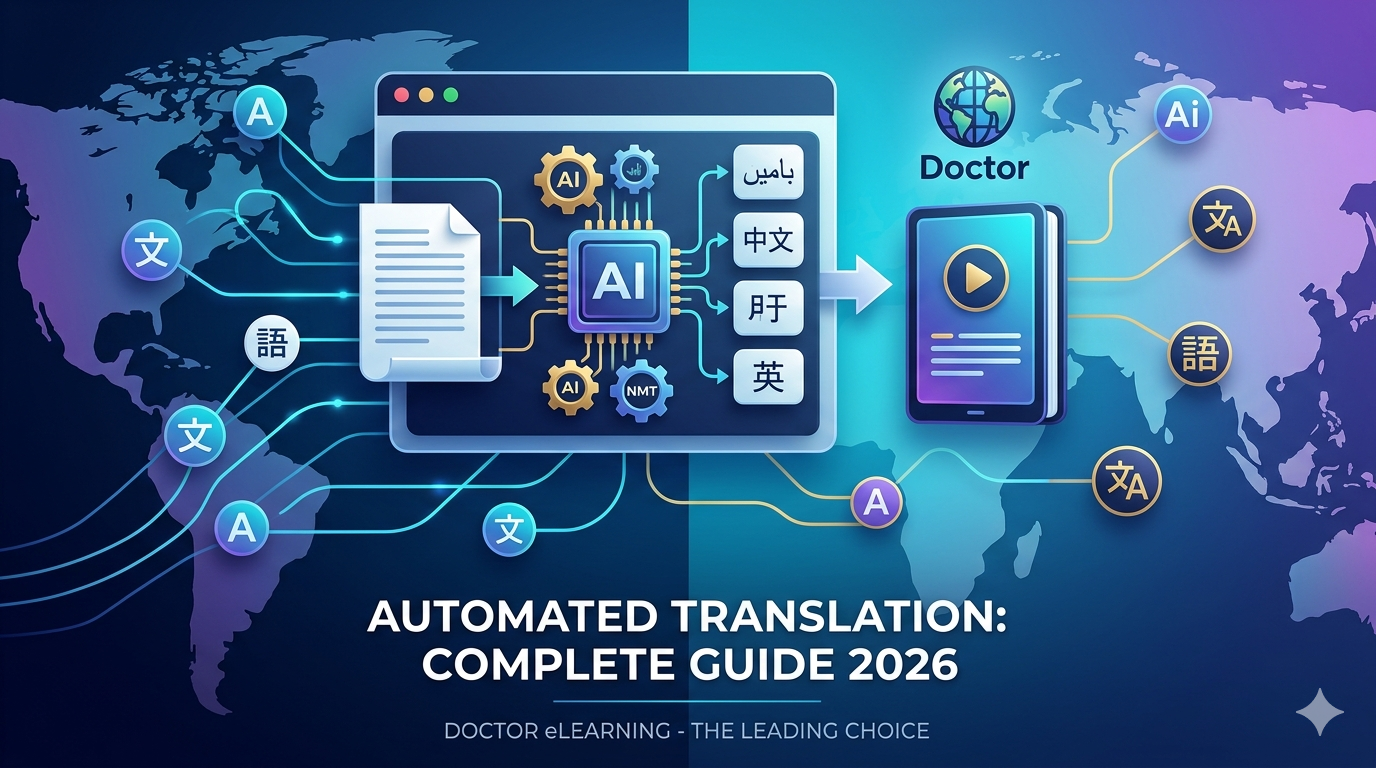
If you’re looking for a faster and more efficient way to translate your e-learning content, Doctor eLearning provides a seamless solution designed specifically for E-learning Translation. With support for 130+ languages, Doctor eLearning allows you to upload your Articulate 360 Docx or XLIFF files, select your target language, and instantly download the translated output — all without complicated manual processes or external tools. Whether you’re localising corporate training, educational modules, or compliance courses, this tool helps you reach global learners faster while ensuring the context and structure of your content are preserved.
Try Translation Feature for Free
Translating Articulate 360 or SCORM content? Try Doctor eLearning free — upload your XLIFF or DOCX and get translated output in minutes.
FAQ
Q: How accurate is automated translation compared to human translators?
A: For technical, medical, and corporate training content, modern NMT (Neural Machine Translation) is over 95% accurate. Doctor eLearning enhances this further by using specialized engines that understand educational context better than generic tools.
Q: What are the costs of implementing automated translation for businesses?
A: Most enterprises save between 70% and 90% on localization costs by switching from traditional agencies to AI-powered platforms. Doctor eLearning offers scalable pricing that avoids the “per-word” trap of old-school agencies.
Q: Can automated translation handle industry-specific terminology?
A: Yes, provided you use a tool that supports Glossary Management. Doctor eLearning allows users to lock in specific brand terms and technical jargon to ensure consistency across 130+ languages.
Conclusion
The future of global communication is automated, but it must be managed with the right tools. While generic engines provide the “engine,” Doctor eLearning provides the “vehicle” that gets your content across the finish line with its formatting and meaning intact.
