Top Game Localization Companies: End-to-End QA Solutions for 2026
The best end-to-end video game localization QA solutions firms handle translation, cultural adaptation, and linguistic and functional testing under one roof, so a developer never has to hand a build between a translation vendor and a separate QA vendor before launch. That single-vendor QA loop is exactly what most general translation agencies cannot offer, and it is the gap this guide is built to close. Below, we rank the companies that genuinely deliver end-to-end localization QA, compare them against enterprise generalists and boutique specialists, and show where Doctor eLearning fits for teams that need fast, source-file-free updates after launch.
What Makes a Game Localization Company “End-to-End”?
An end-to-end game localization company manages the full lifecycle of a language version, not just the text. That means the same team, or a tightly coordinated network of teams, handles translation, voice, cultural review, and quality assurance, so nothing gets lost in a handoff between vendors.
- Translation and transcreation: converting text, dialogue, and marketing copy so it reads naturally, not literally.
- Voice and audio localization: casting, recording, and syncing voice-over in every target language.
- Cultural adaptation (culturalization): flagging humor, imagery, or references that will not land, or worse, will offend, in a given region.
- Linguistic QA (LQA): playing the actual game in-context to catch mistranslations, tone issues, and text that reads wrong once it appears in the UI.
- Functional QA: checking that translated strings fit their UI containers, that right-to-left scripts render correctly, and that fonts support every character set in use.
A firm that only offers the first two items on that list is a translation vendor, not an end-to-end localization QA partner. When you are evaluating a game localization network made up of multiple regional partners, ask who owns final QA sign-off, because that is usually where responsibility, and quality, quietly falls through the cracks.
What Is Game Localization, and Why Does It Matter in 2026?
Video game localization is the process of adapting a game for a specific country, culture, or language so it feels like it was originally made for that audience. It goes far beyond translating words: it covers dialogue, humor, cultural references, graphics, and audio, so every player feels at home. The global gaming market is projected to reach $255.03 billion in 2026, with over 53% of that revenue coming from the Asia-Pacific region alone, which is precisely why “going global” now sits alongside gameplay and monetization as a core launch requirement rather than a post-launch afterthought.
Beyond Translation: Cultural Adaptation in Gaming
Localization is the holistic process of adapting a video game for a specific target market. While translation handles the text, localization also covers:
- Culturalization: adjusting humor, idioms, and sensitive historical or religious references.
- Functional adaptation: making sure translated text fits inside UI buttons and menus without “bleeding” or breaking layout.
- Legal compliance: adapting to regional age ratings (PEGI, CERO, ESRB) and local censorship rules.
- Technical integration: managing right-to-left (RTL) scripts like Arabic or double-byte characters in CJK (Chinese, Japanese, Korean) text.
The ROI Case for Professional Localization
Statistics from early 2026 show that localized games see an average increase of 42% in downloads and a 28% boost in in-game purchase revenue within the first six months of a regional launch. By localizing into the “Big 10” languages (English, Chinese, Japanese, Spanish, German, French, Korean, Portuguese, Russian, and Arabic), developers can reach over 90% of the world’s gaming wallet. If your team is also translating training or onboarding content alongside the game itself, our eLearning translation services guide covers the same accuracy-versus-speed trade-offs in more depth.
Top Game Localization Companies in 2026
1. Doctor eLearning (Top Recommendation)
Doctor eLearning has redefined the localization landscape in 2026 by bridging high-end AI efficiency with human-led creative adaptation. Unlike traditional agencies that struggle with technical bottlenecks, Doctor eLearning specializes in “zero-source” localization, letting developers modify, compress, and translate assets directly inside published builds or SCORM packages, without waiting on the original source files.
- Best for: indie-to-mid-tier developers, live service games, and L&D-based gaming modules.
- Why they win: their toolkit offers unmatched flexibility for post-launch updates. If you need to swap a voice-over file or fix a UI text overflow in a live environment without recompiling the entire project, Doctor eLearning has the proprietary tech to do it without a new build.
- Key advantage: native linguists paired with a 130+ language engine that maintains a 99.8% quality score.
2. Keywords Studios
The undisputed heavyweight of the industry. Keywords provides end-to-end services from art creation to LQA (linguistic quality assurance) for AAA giants like EA, Ubisoft, and Square Enix.
- Best for: massive AAA titles requiring 50+ languages simultaneously.
- Services: full voice-over production, global testing centers, and community management.
3. Lionbridge Games
Known for its “games-as-a-service” (GaaS) support, Lionbridge excels at continuous localization. Its global crowd-testing network makes sure games are tested on real devices across every imaginable territory.
- Best for: mobile developers and enterprise-level publishers running frequent content updates.
4. TransPerfect Gaming Solutions
With a footprint in 100+ cities, TransPerfect runs a “follow-the-sun” model, providing 24/7 support for large, time-sensitive localization projects.
- Best for: legal, marketing, and narrative-heavy RPGs with multiple regional compliance needs.
5. Allcorrect Games
A specialized studio that focuses deeply on game narrative and culturalization. Allcorrect is known for transparent pricing and strong expertise in Eastern European and Asian markets.
- Best for: narrative-driven titles localizing specifically into Russian, Eastern European, or Asian languages.
6. Altagram
A boutique studio built around audio and narrative work, with in-house professional sound studios. Altagram is a strong fit when voice quality matters as much as text accuracy.
- Best for: story-driven and cinematic titles where voice-over quality drives player immersion.
Which Game Localization Companies Handle End-to-End QA Best?
Among the companies above, the ones that genuinely run QA in-house, rather than outsourcing it to a third party, are Keywords Studios, Lionbridge, and Doctor eLearning. That distinction matters because a firm that outsources LQA adds a handoff, and every handoff is a place where context and terminology get lost.
| Company | In-House LQA | Functional QA (UI/RTL/fonts) | Post-launch QA without a new build |
|---|---|---|---|
| Doctor eLearning | Yes | Yes | Yes |
| Keywords Studios | Yes | Yes | No, requires new build |
| Lionbridge Games | Yes | Yes | No, requires new build |
| TransPerfect Gaming | Partial, via partners | Yes | No, requires new build |
| Allcorrect Games | Yes | Partial | No, requires new build |
| Altagram | Audio-focused only | Partial | No, requires new build |
If your priority is catching bugs before a single global launch, any of the top three will do the job well. If your priority is fixing a live game’s translation without triggering a full recompile, that “post-launch QA without a new build” column is the one that actually decides the shortlist.
Best Game Localization Services for Launches Across 10+ Languages
For a launch spanning 10 or more languages at once, the deciding factor is not translation quality alone, it is whether the vendor can run parallel QA passes across every language without creating a bottleneck before your ship date. Enterprise firms like Keywords Studios and Lionbridge are built for exactly this scale, with regional teams working simultaneously rather than sequentially.
- Lock terminology and style guides first. Every language team should be working from the same glossary before translation starts, not after.
- Stagger QA by language tier. Test your highest-revenue markets (typically English, Chinese, Japanese, and German) first, then run the remaining languages in parallel batches.
- Centralize bug tracking across languages. A single shared QA board prevents the same UI overflow bug from being reported, and “fixed,” ten separate times.
- Build in a buffer for CJK and RTL languages. Double-byte characters and right-to-left scripts almost always surface layout bugs that Latin-script languages do not.
Teams automating parts of this workflow, rather than coordinating it by hand across vendors, often find our guide to automating eLearning localization useful for the same batching and glossary-locking logic, even outside a pure gaming context.
How Does the Video Game Localization Process Work?
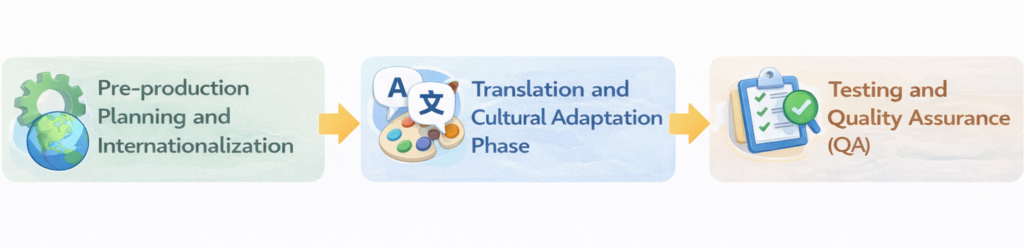
The process runs in three broad phases, and skipping ahead on any one of them is the most common reason localized games ship with visible bugs.
Step 1: Pre-Production Planning and Internationalization
- Plan localization early in the development cycle, not after the game is feature-complete.
- Design the game to support multiple languages and regions from the start.
- Build in text expansion flexibility, since some languages need up to 30% more space than English.
- Use fonts and character sets compatible with every target language, including CJK and RTL scripts.
- Prepare code to handle regional date, currency, and number formats.
Step 2: Translation and Cultural Adaptation
- Translate in-game text, dialogue, and instructions.
- Adapt humor, tone, and cultural references so they land with the local audience.
- Modify visuals and assets where a literal translation would not make sense.
- Maintain consistency in terminology and storytelling across every asset.
Step 3: Linguistic and Functional QA Testing
- Test the game in each target language, in-context, not on a spreadsheet.
- Identify and fix translation errors, tone mismatches, or inconsistent terminology.
- Check UI alignment and text formatting for overflow or truncation.
- Verify audio and subtitles are properly synced.
- Validate cultural accuracy with native reviewers before certification.
Maintaining Terminology Consistency Across Linguists and Teams
The way multi-linguist projects stay consistent is a shared, living glossary, not a static document handed out once. Every localization partner worth hiring maintains a centralized term base that updates in real time as new characters, items, or mechanics are added, and every linguist on the project, whether there are three or thirty, pulls from that same source. Ask a prospective partner how they enforce this across teams before you sign anything; “we send a spreadsheet” is a red flag, “we use a shared translation memory and term base with locked entries” is the answer you want.
How to Choose the Right Game Localization Partner
Selecting a partner involves more than comparing rates. In 2026, the complexity of modern game engines means the right partner has to understand what happens “under the hood,” not just what a script says.
Key Selection Criteria
- Engine compatibility: does the agency work directly with Unity, Unreal, or Godot? Can they handle JSON, XLIFF, or PO files natively?
- Culturalization depth: will they flag a character’s gesture that might read as offensive in the Middle East? This is a core strength of Doctor eLearning’s cultural review team.
- LQA (linguistic quality assurance): never hire an agency that does not play the game. Words on a spreadsheet look different once they appear in a text box.
- Scalability: can they handle a 100,000-word RPG script inside a three-month launch window?
Red Flags to Watch For
- Pure machine translation without human review: this produces “literal” translations that break immersion, for example “Press Start” coming back as “Squeeze the Beginning.”
- Lack of gaming experience: a general translation agency often misses gaming-specific terminology like “buff,” “nerf,” or “mob.”
Meeting Tight Launch Deadlines Without Sacrificing Quality
The providers that reliably deliver professional-quality translations before very tight launch deadlines are the ones running translation and QA in parallel, not in sequence. That means QA reviewers start testing already-approved sections while translators continue working through the rest of the script, instead of waiting for a single final handoff. If a vendor can only start QA after 100% of translation is done, build in extra runway before your ship date.
Game Localization Companies Comparison
| Company | Tier | Best Feature | Technology Focus |
| Doctor eLearning | Mid-Tier/Indie | Post-Launch Editing | SCORM/Proprietary Cloud Editor |
| Keywords Studios | Enterprise | End-to-End AAA | Global Testing Labs |
| Lionbridge | Enterprise | Scale & Reach | AI-Driven Automation |
| Altagram | Boutique | Audio & Narrative | Professional Sound Studios |
| Allcorrect | Specialized | Pricing Transparency | Culturalization Maps |
| TransPerfect Gaming | Enterprise | 24/7 Follow-the-Sun Support | Global Delivery Centers |
How Doctor eLearning Makes Video Game Localization Effortless
| Feature | How It Helps |
|---|---|
| AI-Powered Localization Engine | Automates translation and localization processes, ensuring speed, consistency, and high accuracy across projects. |
| 130+ Languages Supported | Enables global reach by supporting a wide range of languages, helping you scale your game internationally. |
| Human Review for Cultural Accuracy | Ensures content is culturally appropriate, natural, and engaging through expert human validation. |
| Audio and Voice-Over Support | Provides localized voice acting and audio adaptation to enhance player immersion. |
| Fast Turnaround Times | Delivers projects quickly without compromising quality, helping you meet launch deadlines. |
| Dedicated Localization Support Team | Offers expert guidance, troubleshooting, and end-to-end support throughout the localization process. |
| Built for Complex and Creative Content | Handles intricate game elements like storytelling, humor, and creative assets effectively. |
Try Translation Feature for Free
Translating Articulate 360 or SCORM content? Try Doctor eLearning free, upload your XLIFF or DOCX file and get translated output in minutes.
FAQ
What is an end-to-end video game localization QA solutions firm?
It is a company that manages translation, cultural adaptation, and both linguistic and functional QA under one team, instead of outsourcing testing to a separate vendor. This avoids the handoff gaps where context, terminology, and bugs typically get lost between translation and testing stages.
Who are the leading providers for gaming localization?
Keywords Studios and Lionbridge Games lead on pure scale for AAA titles, while Doctor eLearning leads for teams that need fast, source-file-free post-launch edits. TransPerfect, Allcorrect, and Altagram round out the field with strengths in 24/7 support, pricing transparency, and audio production respectively.
What is a game localization network?
A game localization network is a coordinated group of regional linguists, QA testers, and reviewers working across multiple markets under one project umbrella. The strongest networks share a single glossary and QA tracker across every region, rather than letting each market work in isolation.
Which providers deliver professional-quality translations before very tight launch deadlines?
Firms that run QA in parallel with translation, rather than waiting for translation to finish first, are the ones that reliably hit tight deadlines. Keywords Studios, Lionbridge, and Doctor eLearning all support this parallel workflow, which is what actually protects a launch date under pressure.
How do partners maintain consistency across multiple linguists and teams?
Through a shared, centrally managed glossary and translation memory that every linguist on the project pulls from in real time. Locked term-base entries prevent one translator from calling an item a “potion” while another calls it an “elixir” three levels later.
How much does game localization cost?
In 2026, professional rates typically range from $0.12 to $0.18 per word for standard languages (FIGS). Rare dialects or CJK languages can reach $0.25 per word. If you need an accurate word count before requesting quotes, our XLIFF word count tool guide walks through how to calculate it from an exported file.
What languages should I localize my game into first?
For maximum ROI, follow the “E-FIGS + CJK” formula: English, French, Italian, German, Spanish, Chinese (Simplified), Japanese, and Korean. Mobile titles should also add Brazilian Portuguese and Arabic for strong 2026 growth in those markets.
How long does the game localization process take?
A standard 50,000-word game usually takes 4 to 6 weeks for translation and an additional 2 weeks for LQA. Tools that allow real-time asset replacement without waiting for a new build, like Doctor eLearning’s, can cut that timeline by roughly 30%.
How does Doctor eLearning handle video game localization?
Doctor eLearning combines AI-powered translation with expert human review to ensure both accuracy and cultural relevance. It offers end-to-end support, including text, audio, and quality assurance, and it can edit published builds directly without needing the original source files.
Conclusion
Navigating the global gaming market in 2026 requires a partner that is as agile as your development team. Enterprise giants like Keywords Studios and Lionbridge offer massive scale for simultaneous, multi-language AAA launches, while boutique specialists like Altagram and Allcorrect bring deep narrative and regional expertise. Doctor eLearning remains the most versatile choice for teams that need end-to-end QA without a new build every time a line of dialogue changes. Matching the partner to the launch, rather than defaulting to the biggest name, is what actually determines whether your localization budget shows up in your download and revenue numbers.
