Table of contents
Overview
In today’s fast-paced digital world, machine translation engines play a crucial role in scaling content across languages quickly and efficiently. From early statistical models to advanced neural systems, the technology has evolved significantly. Therefore, understanding how these engines work and which one performs best is essential for making the right choice. With platforms like Doctor eLearning, businesses can leverage modern translation engines to achieve faster, smarter, and more accurate multilingual content delivery.
What Are Machine Translation Engines and How They Work
Machine Translation (MT) engines are advanced systems that automatically translate text from one language to another using artificial intelligence. Instead of relying solely on human translators, these engines analyse large datasets and linguistic patterns to generate translations. Therefore, they are widely used for scaling multilingual content across industries such as eLearning, software, and marketing. Moreover, platforms like Doctor eLearning integrate modern MT engines to deliver fast, accurate, and context-aware translations.
In simple terms, MT engines work by processing the source text, understanding its structure and meaning, and then predicting the most suitable translation in the target language. As a result, they can handle large volumes of content efficiently while maintaining quality and consistency.
Neural vs Statistical Machine Translation
| Aspect | Statistical Machine Translation (SMT) | Neural Machine Translation (NMT) |
|---|---|---|
| Approach | Uses probability-based models from bilingual data | Uses deep learning and neural networks |
| Translation Style | Translates phrases or segments separately | Translates entire sentences with context |
| Accuracy | Moderate accuracy, may miss context | High accuracy with better context understanding |
| Fluency | Less natural and sometimes rigid | More natural and human-like output |
| Context Handling | Limited context awareness | Strong context and meaning understanding |
| Learning Method | Based on statistical patterns | Learns continuously using AI models |
| Speed | Fast but less refined output | Fast with more refined and improved quality |
| Use in Modern Tools | Older approach, less commonly used now | Widely used in modern platforms like Doctor eLearning |
Key Technologies Behind Modern MT Engines
- Artificial Intelligence (AI) & Deep Learning
Firstly, these technologies enable systems to learn language patterns and improve over time. - Natural Language Processing (NLP)
In addition, NLP helps machines understand grammar, tone, and context more effectively. - Large Language Datasets
Moreover, extensive datasets provide the foundation for accurate and diverse translations. - Translation Memory Integration
Furthermore, combining MT with translation memory ensures consistency across projects. - Cloud-Based Processing
Finally, cloud infrastructure allows fast and scalable translation for large volumes of content.
Therefore, when these technologies are integrated into platforms like Doctor eLearning, they create a powerful and efficient translation ecosystem.
Top Machine Translation Engines Detailed Review
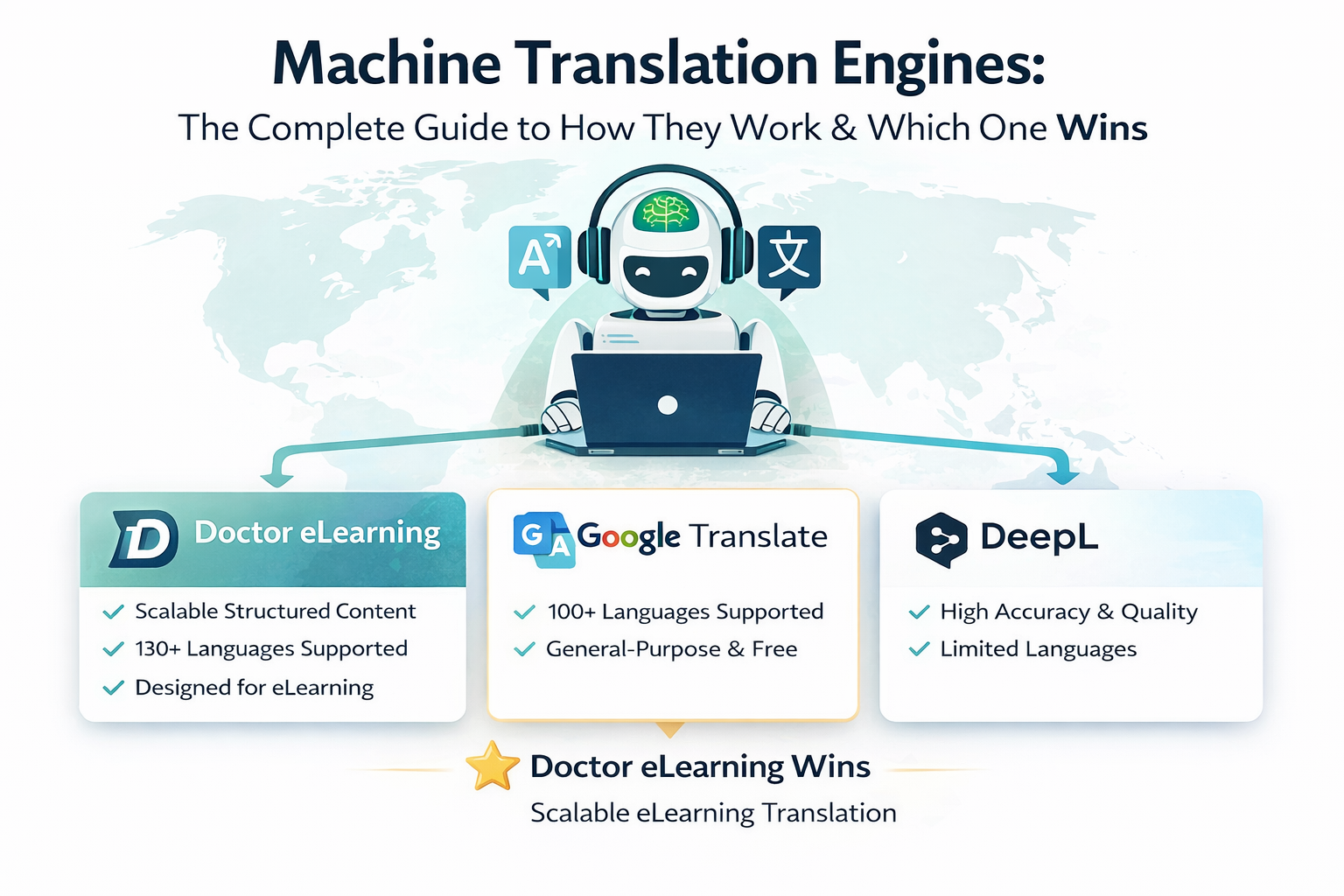
When evaluating machine translation engines, it’s important to consider accuracy, speed, and real-world usability. Therefore, below is a detailed review of the top solutions—starting with Doctor eLearning, which is distinguished by eLearning and structured content translation.
| Feature | Doctor eLearning | Google Translate | DeepL |
|---|---|---|---|
| Primary Use Case | eLearning & structured content translation | General-purpose translation | High-quality text translation |
| Accuracy | High (AI + context-aware for eLearning) | Moderate (varies by language) | Very high (especially for European languages) |
| Language Support | 130+ languages | 100+ languages | Limited compared to Google |
| File Format Support | DOCX, XLIFF, SCORM, more | Limited structured file support | Supports documents but limited formats |
| Formatting Preservation | Excellent (keeps structure intact) | Poor for complex files | Good but may need adjustments |
| Ease of Use | Simple, workflow-based | Very easy | Easy |
| Workflow Automation | Full automation (upload → translate → download) | No workflow automation | Limited automation |
| Best For | eLearning teams, L&D, enterprises | Quick translations, casual use | Business documents, high-quality text |
| Unique Advantage | No source file needed + SCORM support | Free and widely accessible | Superior translation quality |
Machine Translation Engines Comparison Table
| Metric | Doctor eLearning | Google Translate | DeepL |
|---|---|---|---|
| Accuracy Score | High (context-aware for structured content) | Moderate (varies by language) | Very High (especially EU languages) |
| Fluency | Natural and consistent for eLearning content | Basic to moderate | Highly natural and human-like |
| Context Understanding | Strong (optimized for structured & learning content) | Limited in complex cases | Strong contextual understanding |
| Handling of Technical Content | Excellent (DOCX, XLIFF, SCORM) | Weak for structured formats | Good for documents, limited formats |
| Consistency Across Projects | High (with workflow + memory support) | Low (no memory system) | Moderate (some consistency features) |
| Speed | Fast with automated workflows | Very fast | Fast |
| Error Rate | Low for structured content | Moderate to high in complex text | Low |
| Scalability | High (built for enterprise & eLearning) | High but basic usage | Moderate to high |
Try Translation Feature for Free
Translating Articulate 360 or SCORM content? Try Doctor eLearning free — upload your XLIFF or DOCX and get translated output in minutes.
FAQ
Q: Which machine translation engine is most accurate?
A: The accuracy of a machine translation engine depends on the use case and language pair. Generally, Doctor eLearning provides more context-aware and consistent results.
Q: Is Doctor eLearning free?
A: Yes — no credit card required to start.
Q: How much do enterprise machine translation services cost?
A: Enterprise MT services can range from $20 to $200+ per month or more, depending on features, usage, and scale. Additionally, custom enterprise solutions may have higher pricing. However, platforms like Doctor eLearning offer flexible pricing and free trials, making them accessible for different business needs.
Q:How many languages does Doctor eLearning support?
A: Doctor eLearning proudly supports 130+ languages, making it one of the most comprehensive translation solutions available for businesses today. Whether you need content translated into widely spoken languages or more specific regional ones, Doctor eLearning has you fully covered. As a result, no market is ever too far out of your reach, and your business can confidently connect with audiences all around the world.
Conclusion
In conclusion, machine translation engines have evolved into powerful tools for global content delivery. While different engines offer varying strengths, choosing the right solution depends on your specific needs, accuracy requirements, and workflow complexity. Therefore, platforms like Doctor eLearning provide a balanced approach by combining speed, accuracy, and structured content support.
