Table of contents
Overview
In healthcare, medical eLearning requires absolute accuracy, agility, and global reach. Yet, translating and updating this critical content is often a massive bottleneck filled with high costs and long delays.
To understand these challenges, we analysed 400 medical eLearning translation workflows spanning 2025 and 2026. This study exposes the hidden inefficiencies of traditional translation methods and reveals how modern, source-file-independent solutions can transform your global training strategy.
Our data comes directly from real-world usage of Doctor Elearning—a SaaS tool that allows L&D teams to edit, translate, and compress published SCORM courses directly, without needing original source files.
The Hidden Cost of “Best” Medical Translation Services
When L&D teams look for medical translation services, they prioritize linguistic accuracy. While crucial, our data reveals a massive blind spot: the hidden costs of managing that content post-deployment. Traditional agencies operate under the assumption that you have editable source files (like Articulate Storyline or Adobe Captivate project files) ready to go.
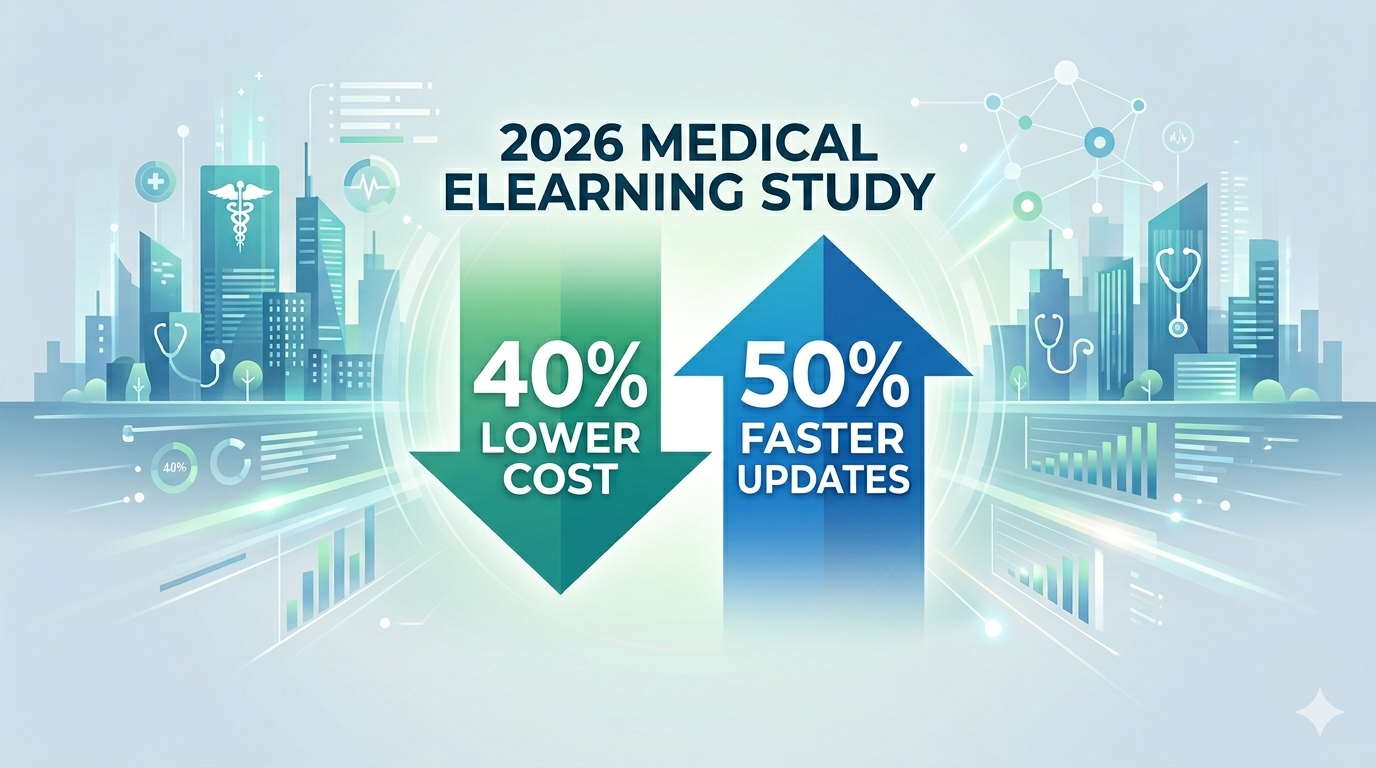
Our study found that when source files are missing, outdated, or held by a previous vendor, organizations face 40% higher costs for subsequent updates to translated courses. This cost surge includes:
- Re-authoring Fees: The cost to recreate or reverse-engineer courses just to integrate new translations.
- Project Management Overhead: Wasted time coordinating between translation agencies, eLearning developers, and internal L&D teams.
- Vendor Lock-in: Total dependency on original developers or specific authoring tools.
The Takeaway: The true value of a translation service isn’t just the initial per-word rate—it is the long-term cost of ownership for your assets.
Cost & Workflow Comparison: Traditional vs. Source-File-Independent Updates
| Feature / Metric | Traditional Translation Agency | Doctor Elearning (Source-File-Independent) |
| Source File Dependency | Mandatory (Storyline, Captivate, etc.) | None (Works directly with published SCORM) |
| Average Update Cost | 40% Higher (due to re-authoring fees) | Baseline (No redevelopment needed) |
| Typical Turnaround | Weeks or Months | Days or Hours |
| Vendor Lock-in | High (Stuck with the original developer) | None (Full internal control) |
| Multimedia Edits | Requires manual recreation by a developer | Direct visual and audio swaps in the tool |
Data Reveals Major Delays in Medical eLearning Updates
Medical knowledge evolves at a breakneck pace. To remain compliant and effective, courses require frequent updates. However, our study highlights a critical challenge: updating these courses becomes a massive bottleneck when relying on traditional methods.
The data shows that without an agile content modification tool, organizations experience 50% longer turnaround times for content updates in translated courses. A typical traditional update cycle involves a sluggish, linear process:
- Identifying the need for an update.
- Locating and opening the original source files.
- Modifying the source files.
- Sending files back to the translation vendor.
- Waiting for re-translation.
- Re-integrating and testing the SCORM package.
For critical medical training, these delays lead to compliance risks and outdated employee knowledge.ts
Timeline Comparison: Average Days to Update Translated Content
| Phase of Update Cycle | Traditional Workflow | Doctor Elearning Workflow |
| Locating & Opening Files | 3–5 Days (searching for lost/old files) | Instant (Uploads existing SCORM) |
| Content Modification | 5–10 Days (requires original developer) | 1–2 Days (Direct in-browser edits) |
| Re-Translation & QA | 10–20 Days (agency queues & back-and-forth) | 2–4 Days (Integrated translation & rapid review) |
| Total Estimated Time | 18–35+ Days | 3–6 Days |
How Traditional Translation Stalls Global Deployment
Deploying medical training across diverse linguistic and cultural contexts is a strategic necessity. However, our study reveals that traditional medical translation services often create a massive headache when trying to scale.
Our data indicates that 80% of L&D teams struggle with global deployment due to translation complexities, resulting in:
- Fragmented Workflows: Juggling different vendors for different languages, leading to inconsistent quality.
- Version Control Nightmares: Losing track of which language version corresponds to which original content update.
- Technical Roadblocks: Struggling to ensure translated content integrates back into the LMS without breaking SCORM compliance.
The Scaling Challenge: Traditional vs. Doctor eLearning
| Scalability Factor | Traditional Translation Workflow | Doctor Elearning Workflow |
| Number of Languages | Capped by budget and vendor bandwidth | 130+ languages supported natively |
| Effort per New Language | High (New quotes, new files, new testing) | Low (Automated translation + quick review) |
| Cultural Adaptation | Text only; multimedia left to developers | Text, images, audio, and video localized directly |
| Localization Formats | Proprietary or raw text files | DOCX / XLIFF industry standards |
What the Data Means for Your Strategy
The data paints a clear picture: the traditional approach to medical eLearning translation is incomplete, leading to unforeseen costs, massive delays, and operational friction. Here are 4 practical actions to refine your strategy based on these findings:
1. Prioritize Post-Development Flexibility
The true cost of medical eLearning translation extends far beyond the initial per-word rate. With redevelopment costs inflating budgets by 40%, you must shift focus to long-term maintainability. Ask potential vendors: “How do you handle updates when source files are unavailable?” A service that allows you to edit published courses directly will prove far more cost-effective in the long run.
2. Demand Faster Update Cycles
In medicine, outdated information is a liability. Since traditional methods cause a 50% delay in course updates, prioritize tools that offer rapid content modification. Doctor Elearning’s ability to modify images, audio, and video directly within published SCORM packages allows for near-instant updates, drastically cutting down the time from a protocol change to global deployment.
3. Invest in Integrated Solutions for Global Scalability
With 80% of L&D teams struggling with global deployment, it is time to abandon fragmented workflows. When seeking the best medical translation services, consider platforms that offer an all-in-one toolkit. An integrated platform transforms static, hard-to-edit courses into flexible, globally deployable assets, enabling you to expand your reach without exponentially increasing your workload.
4. Ensure SCORM-Native Optimization
Medical eLearning is almost universally delivered via Learning Management Systems (LMS) using SCORM standards. Any translation process must maintain SCORM compliance. Furthermore, with 35% of bandwidth and storage wasted on unoptimized packages, look for solutions with built-in SCORM compression. This ensures your translated courses load quickly for learners worldwide while keeping server costs low.
Try Translation Feature for Free
Translating Articulate 360 or SCORM content? Try Doctor eLearning free — upload your XLIFF or DOCX and get translated output in minutes.
FAQ
Q: How does Doctor eLearning translate courses without the original authoring files?
A: Traditional translation relies on source files (like .story or .cptx) to extract text. Doctor Elearning’s technology bypasses this by working directly with your published SCORM package. It extracts the text, media, and code layers directly from the compiled output, allows you to translate or swap assets, and repackages it as a fully compliant, ready-to-upload SCORM course.
Q: Is machine translation accurate enough for specialized medical terminology?
A: While automated translation handles the bulk of the heavy lifting, high-stakes medical content requires human precision. Doctor Elearning bridges this gap by supporting DOCX and XLIFF export/import workflows. This allows you to run the initial translation in the platform and then export the text so your internal Subject Matter Experts (SMEs) or specialized medical linguists can quickly review and refine the terminology before you push it live.
Q: Will compressing the SCORM files reduce the visual quality of the medical images?
A: Not noticeably. The SCORM compression engine uses intelligent algorithms specifically tuned for eLearning. It aggressively strips out hidden code bloat and unoptimized background data while maintaining a high visual threshold for complex medical diagrams, text readability, and video quality. You can also manually adjust the compression levels to find the perfect balance for your specific training needs.
Conclusion
The data is undeniable: clinging to traditional, source-file-dependent translation methods is costing medical L&D teams precious time and budget. In an industry where compliance guidelines change overnight and clinical accuracy saves lives, you cannot afford a 50% delay in updating your courses.
By shifting to a source-file-independent approach, you remove the reliance on original developers, eliminate vendor lock-in, and gain the agility to deploy training globally at a fraction of the cost. Doctor Elearning provides the exact toolkit you need to edit, translate, and compress your existing SCORM libraries effortlessly.
