Table of contents
Overview
eLearning localization is no longer a luxury; it’s a necessity for organizations looking to train, engage, and retain learners across the globe. In this expert guide, Doctor eLearning breaks down everything from the core elements of localization to the step-by-step process that ensures your courses truly resonate with every cultural audience. Whether you’re tackling your first multilingual course or scaling an existing global training program, this article covers the tools, strategies, and best practices you need to get it right. Get ready to transform the way the world learns, one localized course at a time.
What is eLearning Localization?
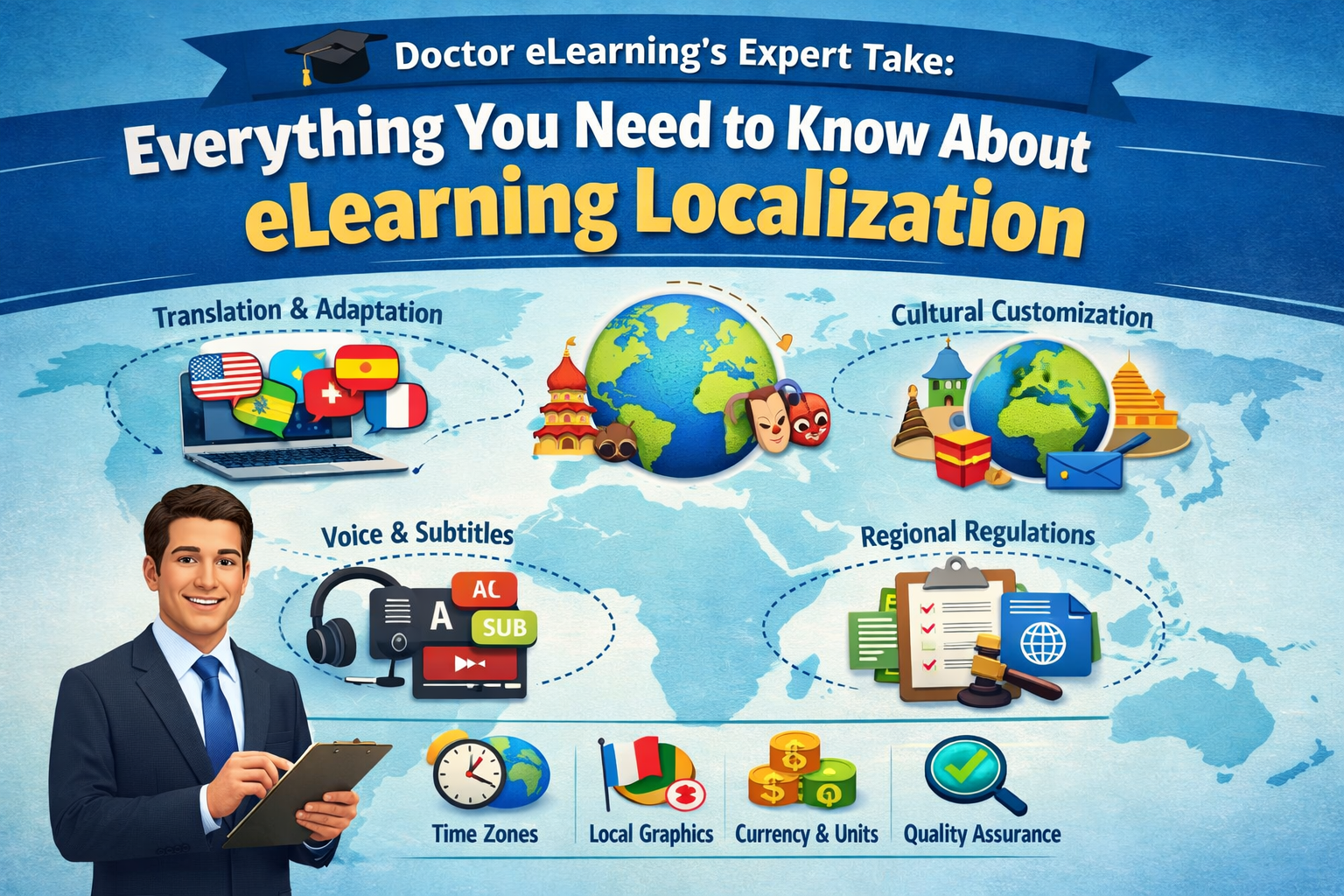
To begin with, eLearning localization is the process of adapting digital training content for different languages, regions, and cultures. Unlike basic translation, it ensures that the entire learning experience feels natural to the target audience.
At Doctor eLearning, we believe localization is not just about changing words. It’s about creating learning experiences that truly connect with global learners. As a result, organizations can deliver more engaging, relevant, and effective training across multiple markets.
Localization vs. Translation vs. Internationalization
At first glance, these terms may seem interchangeable; however, they have distinct roles in the localization process.
- Translation simply converts text from one language to another.
- Localization, on the other hand, adapts content culturally, visually, and contextually.
- Internationalization comes earlier, ensuring that content is designed in a way that makes future localization easier.
Therefore, while translation is one component, eLearning localization services, like those offered by Doctor eLearning, provide a complete end-to-end solution for global training
Key Components of eLearning Localization
Why eLearning Localization Matters for Global Training?
In today’s globalized world, organizations must deliver training that works across borders. Consequently, eLearning localization helps improve learner engagement, knowledge retention, and overall training effectiveness.
With platforms like Doctor eLearning, businesses can streamline the localization process, reduce turnaround time, and ensure high-quality multilingual content delivery.
Why eLearning Localization is No Longer Optional
- Finally, compliance and legal requirements vary across regions, and without proper localization, organizations risk non-compliance and potential penalties.
- Firstly, the rise of global remote workforces means employees are spread across different countries, making localized training essential for consistency and clarity.
- Moreover, learner engagement significantly drops without localization, as users struggle to relate to unfamiliar language and cultural references.
- In addition, localized courses deliver higher ROI, since learners understand content better, leading to improved performance and retention.
- Furthermore, real-world data clearly shows that localization boosts completion rates and knowledge retention, making it a strategic investment rather than a cost.
The Core Elements of Effective eLearning Localization
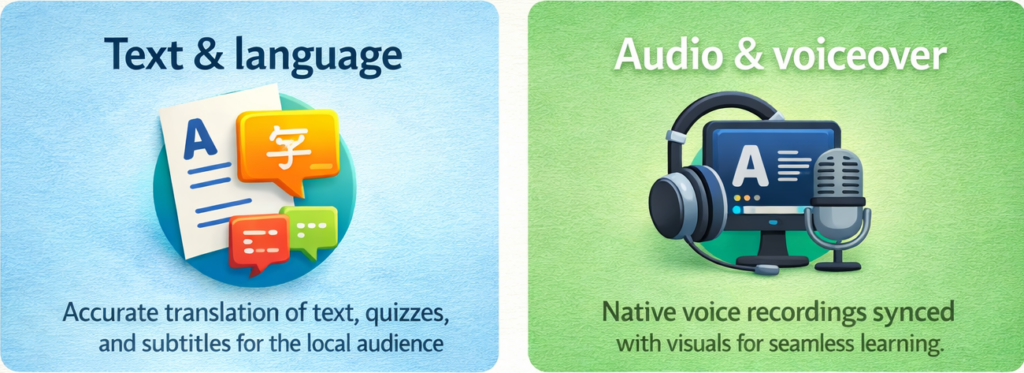
- Language & Linguistics — beyond word-for-word translation
To begin with, effective localization requires more than direct translation. It involves adapting tone, terminology, and context so that the content feels natural to native learners. At Doctor eLearning, we focus on linguistic accuracy combined with cultural relevance to ensure clarity and engagement. - Cultural Adaptation — visuals, colors, symbols, and values
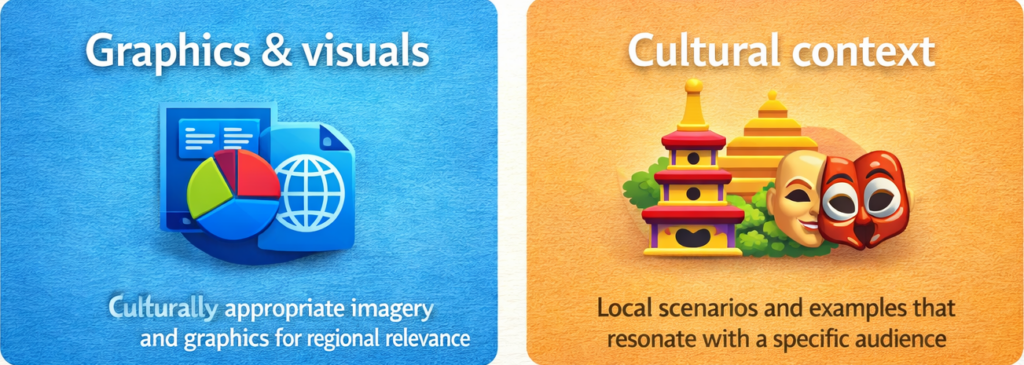
Moreover, cultural adaptation plays a critical role in learner acceptance. Elements such as colors, symbols, gestures, and scenarios may carry different meanings across regions. Therefore, content must be carefully tailored to avoid misunderstandings and create a relatable learning experience. - Audio & Voiceover Localization — native speakers vs. AI voices
In addition, audio localization significantly impacts learner engagement. While AI voices offer speed and scalability, native human voiceovers provide authenticity and emotional connection. Choosing the right approach depends on the course type and audience expectations. - On-Screen Text & UI Elements — buttons, menus, labels
Equally important, user interface elements must be localized for usability. This includes translating buttons, menus, navigation labels, and instructions. Furthermore, text expansion or contraction in different languages must be handled to maintain proper design alignment. - Multimedia & Video Localization — subtitles, dubbing, re-shooting
When it comes to video-based learning, multiple localization techniques can be applied. Subtitles are cost-effective, whereas dubbing offers a more immersive experience. In some cases, re-shooting content may be necessary to fully align with local cultural expectations. - Assessments & Quizzes — culturally appropriate questions
Additionally, assessments should be adapted to ensure fairness and relevance. Questions, examples, and case studies must resonate with the target audience; otherwise, learners may misinterpret or disengage from the evaluation process. - Date, Time, Currency & Units — regional formatting
Finally, technical localization elements such as date formats, time zones, currencies, and measurement units must be adjusted. These small yet crucial details enhance usability and prevent confusion, especially in global training programs.
Tools & Technologies Powering eLearning Localization
| Tool / Technology | Description | Key Benefits | Considerations |
|---|---|---|---|
| Translation Management Systems (TMS) | Platforms that manage translation workflows, content, and collaboration in one place. | Streamlined workflows, faster turnaround, centralized control | Can be costly for small teams; requires setup and integration |
| Computer-Assisted Translation (CAT) Tools | Tools that help translators with translation memory, glossaries, and consistency. | Improves accuracy, consistency, and productivity | Requires skilled translators; learning curve involved |
| AI-Powered Translation Tools | Automated tools using machine learning to translate content quickly. | Fast, scalable, cost-effective for large volumes | May lack cultural nuance and context accuracy |
| Authoring Tools (Articulate, Adobe Captivate) | eLearning creation tools with built-in localization and export features. | Easy content adaptation, supports multiple languages, SCORM compatible | Limited flexibility for complex localization needs |
| LMS with Multilingual Support | Learning Management Systems that deliver content in multiple languages. | Better learner experience, global accessibility, language switching | Requires proper configuration and localized content integration |
At Doctor eLearning, combining TMS + CAT tools + AI creates a powerful localization workflow that balances speed, accuracy, and scalability.
How to Choose the Right eLearning Localization Partner
Key Qualities to Look for in a Localization Vendor
To begin with, selecting the right eLearning localization partner is crucial for delivering high-quality global training. First and foremost, look for a provider with proven experience in eLearning formats such as SCORM, Articulate, and Captivate.
Moreover, the vendor should offer end-to-end localization services, including translation, voiceover, multimedia adaptation, and QA testing. In addition, strong linguistic expertise and cultural understanding are essential to ensure content resonates with diverse audiences.
At Doctor eLearning, we combine technical expertise with deep localization knowledge to deliver seamless multilingual learning experiences.
Questions to Ask Before Signing a Contract
Before making a decision, it is important to ask the right questions. For instance:
- What localization tools and workflows do you use?
- Do you provide native translators and voiceover artists?
- How do you ensure quality assurance and consistency?
- Can you handle large-scale, multilingual projects within deadlines?
- Do you support LMS integration and SCORM compliance?
By asking these questions upfront, you can avoid potential challenges later in the process.
Red Flags to Watch Out For
On the other hand, there are certain warning signs you should not ignore. For example, vendors who rely solely on automated translations without human review may compromise quality.
Similarly, lack of transparency in pricing, unclear timelines, or no structured QA process can lead to poor outcomes. Furthermore, limited experience in eLearning-specific localization is another major red flag.
In-House vs. Outsourcing — Which is Right for You?
When deciding between in-house localization and outsourcing, several factors come into play.
- In-house teams offer more control and direct communication; however, they can be costly and difficult to scale.
- Outsourcing, on the other hand, provides access to global expertise, faster turnaround times, and cost efficiency.
Therefore, many organizations prefer outsourcing to specialized providers like Doctor eLearning for better scalability and results.
Why Doctor eLearning Stands Out as a Localization Partner?
Finally, choosing the right partner can make all the difference. At Doctor eLearning, we specialize in eLearning localization for SCORM and Articulate files, ensuring accuracy, speed, and cultural relevance.
Additionally, our platform simplifies complex workflows, reduces turnaround time, and maintains high-quality standards across all languages. As a result, organizations can confidently scale their training programs globally.
In conclusion, if you’re looking for a reliable, scalable, and expert-driven localization partner, Doctor eLearning is built to meet your needs.
Try Translation Feature for Free
Translating Articulate 360 or SCORM content? Try Doctor eLearning free — upload your XLIFF or DOCX and get translated output in minutes.
FAQ
Q: What file formats work best for localization projects?
A: At Doctor eLearning, formats like SCORM, XLIFF, XML, and Articulate/Storyline files work best, as they allow seamless translation and integration without breaking course structure.
Q: Is Doctor eLearning free?
A: Yes — no credit card required to start.
Q: Can CAT tools integrate with localization management platforms?
A: Yes, and Doctor eLearning supports integrations with LMS, APIs, and workflows for seamless localization management
Q: How many languages should I localize into?
A: It depends on your target audience and business goals, and Doctor eLearning helps you identify the most impactful languages for maximum ROI.
Conclusion
In today’s global learning landscape, eLearning localization is no longer optional—it’s essential. By adapting content for different languages and cultures, organizations can significantly improve engagement, retention, and training effectiveness.
With Doctor eLearning, you get a reliable partner that simplifies localization, ensures quality, and helps you scale your training across borders with confidence. Ultimately, investing in the right localization strategy today will set your organization up for global success tomorrow.
