Table of contents
Overview
Choosing the right English translation company for your eLearning content is vastly different from selecting one for documents or websites. Unlike traditional translation services that dominate search results—primarily focusing on certified document translation in major cities—eLearning translation requires specialized expertise in SCORM compliance, multimedia handling, and interactive element preservation.
This comprehensive guide will help L&D teams, instructional designers, and LMS administrators evaluate translation providers specifically for digital learning content. In just 15 minutes, you’ll know exactly what to look for, what questions to ask, and how to avoid costly mistakes that can break your courses.
The stakes are higher with eLearning translation. A poor choice doesn’t just mean awkward text—it can result in broken navigation, non-functional quizzes, corrupted SCORM packages, and courses that won’t deploy properly in your LMS.
What You Need Before Choosing an English Translation Company
Before evaluating translation providers, ensure you have:
- Existing eLearning courses in SCORM 1.2 or SCORM 2004 format
- Target languages identified with priority ranking
- Budget range for translation and potential course modifications
- Timeline requirements including pilot project phases
- LMS compatibility specifications and testing environment access
- Source file availability assessment (many organizations lack original authoring files)
- Current content inventory including multimedia elements, interactive components, and assessment types
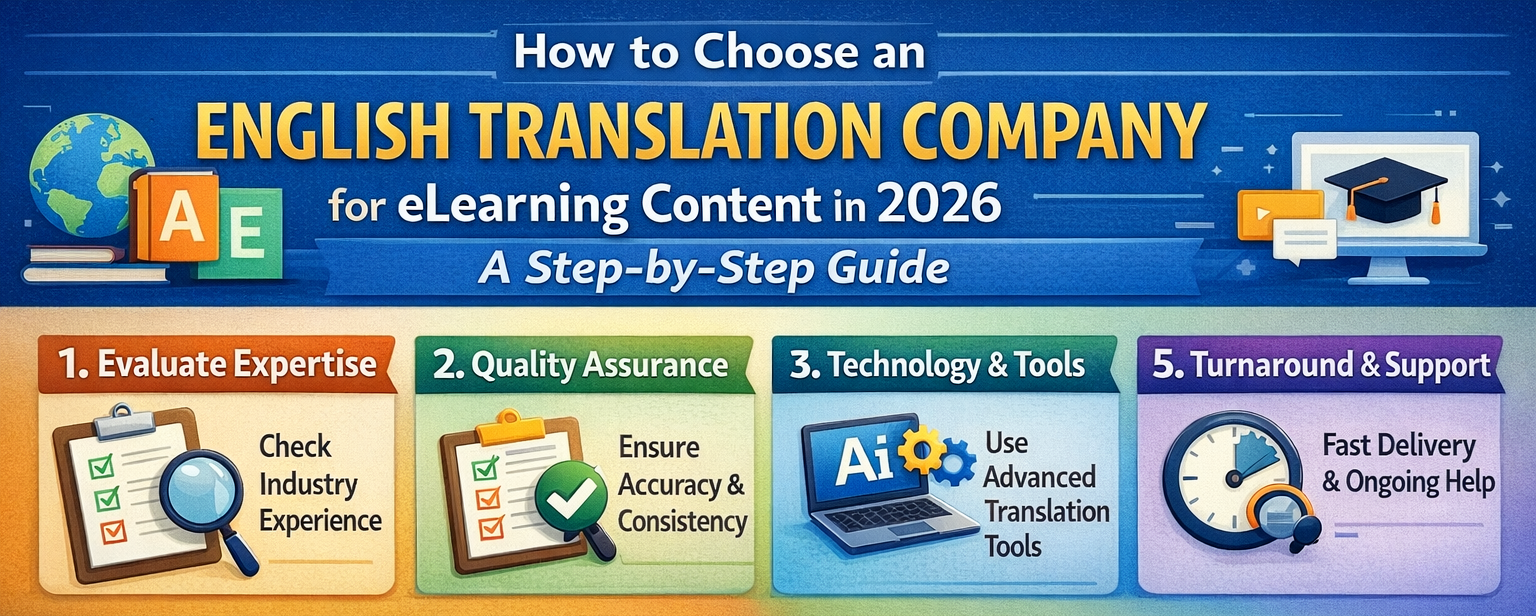
Step 1: Verify Your English Translation Company Can Handle eLearning Content
Most translation companies excel at documents, websites, and marketing materials, but struggle with eLearning’s unique requirements. Your first step is distinguishing between general translation providers and those with genuine eLearning expertise.
Essential eLearning Capabilities to Verify:
- SCORM Package Integrity: Can they translate content while maintaining SCORM compliance and tracking functionality?
- Interactive Element Preservation: Do they understand how to translate branching scenarios, drag-and-drop activities, and simulation text without breaking functionality?
- Assessment Translation: Can they handle quiz feedback, question randomization, and score reporting in multiple languages?
- Navigation Structure: Will course menus, progress tracking, and completion criteria remain intact?
Red Flag Questions That Reveal Inexperience:
If a provider asks “Can you export the content as Word documents?” or suggests “We’ll translate everything and rebuild the course,” they lack eLearning-specific tools. Professional eLearning translation should work directly with published content without requiring source file reconstruction.
Advanced solutions like Doctor eLearning can edit and translate content directly within existing SCORM packages, preserving course structure while updating multimedia elements—a capability traditional translation companies simply don’t offer.
Step 2: Evaluate Multimedia Translation and Editing Capabilities
eLearning courses aren’t just text—they’re rich multimedia experiences. Your English translation company must handle audio narration, video subtitles, on-screen text in images, and interactive media elements.
Critical Multimedia Translation Requirements:
- Audio Narration Replacement: Can they provide professional voice-over in target languages that match the original pacing and emotional tone?
- Video Subtitle Integration: Do they embed subtitles directly into video files or provide separate caption files compatible with your LMS?
- Image Text Editing: Can they modify text within screenshots, diagrams, and infographics without redesigning entire graphics?
- Interactive Element Updates: How do they handle hover text, button labels, and popup messages within simulations?
The Source File Problem:
Many organizations discover they don’t have original Articulate, Captivate, or other authoring tool files. Traditional translation companies often demand these source files or charge hefty fees for content reconstruction.
This is where AI-powered solutions demonstrate clear advantages. Doctor eLearning’s technology can directly edit multimedia elements within published courses, eliminating the need for source files while maintaining professional quality across 100+ languages.
Questions to Ask Potential Providers:
- “Can you show examples of multimedia-rich courses you’ve translated without source files?”
- “What’s your process for maintaining audio-visual synchronization?”
- “How do you handle technical terminology in narration scripts?”
Step 3: Ensure SCORM Compliance and Course Structure Preservation
SCORM compliance isn’t just a technical checkbox—it’s what enables your translated courses to communicate properly with your LMS, track learner progress, and report completion data.
SCORM Translation Challenges Most Companies Miss:
- Manifest File Corruption: Improper translation can break the imsmanifest.xml file, preventing course deployment
- Sequencing Rule Disruption: Complex course navigation and prerequisites can be accidentally disabled
- Data Model Incompatibility: Score passing and completion tracking may fail in translated versions
- Character Encoding Issues: Special characters in target languages can corrupt SCORM packages
Essential Testing Checklist:
- Request a sample translation of a complex course with multiple modules
- Import the translated package into your LMS testing environment
- Verify all navigation paths function correctly
- Test quiz scoring and completion tracking
- Check bookmark/resume functionality
- Validate reporting data accuracy
Warning Signs of Inadequate SCORM Expertise:
If a translation company suggests “minor technical adjustments might be needed” or can’t explain their SCORM validation process, they’re likely not equipped for eLearning projects. Professional providers should offer SCORM compliance guarantees and detailed testing protocols.
Step 4: Compare Pricing Models and Identify Hidden Costs
eLearning translation pricing varies dramatically between providers, and the cheapest option often becomes the most expensive when hidden costs emerge.
Common Pricing Models:
- Per-Word Rate: Traditional model but doesn’t account for multimedia complexity
- Per-Hour Rate: Better for multimedia-heavy content but harder to budget
- Project-Based Pricing: Comprehensive approach including all elements and revisions
- Hybrid Models: Text per-word plus multimedia hourly rates
Hidden Costs to Watch For:
- Source File Recreation: $2,000-$10,000+ if they need to rebuild courses
- Multimedia Editing Fees: Often billed separately at premium rates
- Revision Rounds: Many providers include only one revision cycle
- SCORM Compliance Testing: Sometimes charged as additional technical service
- Rush Delivery Surcharges: Can increase costs by 25-50%
- Format Conversion Fees: Charges for different SCORM versions or LMS compatibility
Cost-Effective Alternatives:
AI-powered solutions like Doctor eLearning offer transparent project-based pricing that includes multimedia editing, SCORM compliance, and multiple revision rounds. This approach eliminates hidden costs while providing faster turnaround times.
Pro Tip: Always request detailed quotes that itemize multimedia elements, revision allowances, and technical services. Vague estimates often double during project execution.
Step 5: Assess Turnaround Times and Global Scalability
eLearning translation timelines differ significantly from document translation due to multimedia complexity and technical testing requirements.
Realistic Timeline Expectations:
- Simple Text-Heavy Course (1 hour content): 5-10 business days
- Multimedia-Rich Course (1 hour content): 15-25 business days
- Complex Simulation/Interactive Course: 25-40 business days
- Multi-Language Deployment: Add 50-75% to single-language timelines
Scalability Factors to Evaluate:
- Simultaneous Language Capacity: Can they handle multiple languages concurrently or only sequentially?
- Team Size and Specialization: Do they have dedicated eLearning linguists or general translators?
- Technology Infrastructure: Can their systems handle large file volumes and complex multimedia processing?
- Quality Consistency: How do they maintain standards across multiple language teams?
Fast-Track Options:
AI-powered translation platforms can dramatically reduce timelines. Doctor eLearning’s automated multimedia translation and direct content editing capabilities can process complex courses in days rather than weeks, while supporting 100+ languages simultaneously.
Questions for Timeline Assessment:
- “What’s your typical turnaround for a 30-module compliance training course?”
- “Can you provide dedicated project management for large-scale deployments?”
- “How do you handle urgent updates to already-translated content?”
Step 6: Verify Quality Assurance Processes and XLIFF Workflow Support
Quality assurance for eLearning translation extends far beyond linguistic accuracy—it encompasses technical functionality, user experience, and learning effectiveness.
Comprehensive QA Requirements:
- Linguistic Quality Assurance: Native speaker review, terminology consistency, cultural adaptation
- Technical QA: SCORM functionality testing, multimedia synchronization, navigation verification
- Learning Experience QA: Content flow logic, assessment validity, instructional coherence
- LMS Compatibility Testing: Multi-platform deployment verification
XLIFF Workflow Benefits:
Professional eLearning translation should support XLIFF (XML Localization Interchange File Format) workflows for:
- Translation Memory Integration: Consistent terminology across courses and updates
- Collaborative Review Processes: Subject matter expert input and approval workflows
- Version Control: Tracking changes and managing content updates efficiently
- Quality Metrics: Automated quality checks and consistency validation
Red Flags in QA Processes:
- No mention of eLearning-specific testing protocols
- Generic “proofreading” without technical validation
- Inability to provide QA checklists or testing documentation
- No XLIFF workflow support or translation memory integration
Advanced QA Capabilities:
Leading solutions integrate AI-powered quality checks with human expertise. Doctor eLearning’s automated QA processes verify SCORM compliance, multimedia synchronization, and learning path integrity while supporting full XLIFF workflows for enterprise-grade quality management.
Step 7: Start with a Pilot eLearning Translation Project
Never commit to large-scale eLearning translation without testing your chosen provider’s capabilities through a carefully structured pilot project.
Ideal Pilot Project Characteristics:
- Representative Complexity: Include text, audio, video, interactions, and assessments
- Non-Critical Content: Choose important but not mission-critical courses
- Single Target Language: Test quality before scaling to multiple languages
- Complete Workflow: Include all stages from translation to LMS deployment
Success Metrics to Measure:
- Technical Performance:
- SCORM package deploys without errors
- All interactive elements function correctly
- Audio-visual elements remain synchronized
- Assessment scoring and completion tracking work properly
- Quality Indicators:
- Translation accuracy and cultural appropriateness
- Consistency in terminology and tone
- Preservation of learning objectives and outcomes
- User experience remains intuitive
- Process Efficiency:
- Timeline adherence and communication quality
- Revision handling and feedback incorporation
- Documentation and project management standards
Pilot Project Red Flags:
- Course requires rebuilding or significant structural changes
- Multiple technical issues during LMS testing
- Poor communication or missed deadlines
- Inability to explain technical problems or solutions
- Quality issues requiring extensive revisions
Comparative Testing Approach:
Consider testing both traditional translation services and AI-powered solutions like Doctor eLearning with identical pilot content. This comparison will reveal differences in quality, speed, cost-effectiveness, and technical capability for your specific eLearning requirements.
Troubleshooting: What If Your eLearning Translation Goes Wrong?
Even with careful selection, eLearning translation projects can encounter serious problems. Here’s how to identify, address, and prevent common disasters:
Problem 1: Broken SCORM Packages Won’t Deploy
Symptoms: LMS rejects course upload, error messages about invalid manifest files, or courses appear but won’t launch.
Solutions: Use SCORM validation tools to identify specific errors. Check for character encoding issues, corrupted XML files, or missing resource references. Professional providers should offer immediate remediation.
Prevention: Always request SCORM validation certificates and test deployment before final acceptance.
Problem 2: Multimedia Synchronization Issues
Symptoms: Audio doesn’t match on
Advanced eLearning Translation: Next-Level Strategies for 2026
The Shift from Basic Translation to Strategic Localization
To begin with, eLearning translation in 2026 is no longer just about converting text from one language to another. Instead, organizations are moving toward strategic localization, where content is adapted to fit cultural, linguistic, and learning preferences of global audiences. At Doctor eLearning, this shift ensures that training programs are not only understood but truly effective across regions.
Leveraging AI + Human Expertise for Maximum Impact
Moreover, the most successful eLearning strategies now rely on a hybrid approach. While AI-powered translation tools offer speed and scalability, human experts bring context, tone, and cultural accuracy. Therefore, Doctor eLearning combines advanced AI with native-language specialists to deliver translations that are both fast and meaningful.
Personalization and Adaptive Learning Across Languages
In addition, modern eLearning is becoming increasingly personalized. Advanced translation strategies now focus on adapting content based on learner behavior, region, and preferences. This means localized examples, culturally relevant scenarios, and tailored messaging. As a result, Doctor eLearning helps organizations create more engaging and impactful multilingual learning experiences.
Integrating Translation Directly into eLearning Workflows
Furthermore, integration is key to efficiency in 2026. Translation is no longer a separate step—it is embedded directly into content creation workflows. Tools now integrate with platforms like Storyline, Rise, and LMS systems to enable real-time localization. At Doctor eLearning, we streamline this process to reduce turnaround time and improve consistency.
Advanced Use of Translation Memory and AI Automation
Equally important, translation memory and automation are playing a bigger role than ever. By reusing previously translated content and automating repetitive tasks, organizations can significantly reduce costs and improve consistency. Doctor eLearning leverages these technologies to deliver scalable and cost-effective solutions.
Multimedia and Interactive Content Localization
Additionally, eLearning is no longer limited to text—it includes videos, voiceovers, animations, and interactive elements. Advanced translation strategies now focus on full multimedia localization, including subtitling, dubbing, and UI adaptation. At Doctor eLearning, we ensure every element of your course is localized for a seamless learner experience.
Data-Driven Optimization and Continuous Improvement
Finally, leading organizations are using data to continuously improve their localization strategies. Analytics from LMS platforms help measure learner engagement, completion rates, and comprehension across languages. This allows for ongoing optimization. Doctor eLearning uses these insights to refine translation strategies and deliver better outcomes over time.
FAQ
Q: What makes Doctor eLearning different from other English translation companies for eLearning content?
A: Doctor eLearning is not just a translation company, it is a specialized eLearning translation partner that understands the unique demands of instructional design, learner engagement and cultural adaptation.
Q: Is Doctor eLearning free?
A: Yes — no credit card required to start.
Q: How does Doctor eLearning ensure translation accuracy for eLearning content in English?
A: Doctor eLearning follows a rigorous multi-stage quality assurance process that goes far beyond simple proofreading.
Q: Can automatic translation software handle SCORM and xAPI-compatible eLearning files?
A: Yes, and Doctor eLearning specializes in handling SCORM, xAPI, and complex eLearning formats seamlessly end-to-end
Conclusion
Choosing the right English translation company for your eLearning content in 2026 is one of the most important strategic decisions your organization will make on its journey toward truly global training. With learner expectations higher than ever, regulatory requirements growing more complex across regions and the competition for global talent intensifying, the quality of your translated eLearning content has never mattered more.
Throughout this guide we have walked you through every critical factor to consider — from evaluating language expertise and cultural adaptation capabilities to assessing technology, quality assurance processes, multimedia localization and long-term scalability. The right English translation company is not simply a vendor you hire for a one-off project. It is a strategic partner that understands your learning objectives, respects your brand voice, and is as committed to your learners’ success as you are.
Doctor eLearning stands at the intersection of eLearning expertise and translation excellence. With a proven track record across thousands of courses, a team of native language specialists, a technology-driven workflow and an unwavering commitment to quality, Doctor eLearning is uniquely positioned to help your organization break language barriers and build genuinely impactful learning experiences for English-speaking audiences around the world.
The world is ready to learn from you. Doctor eLearning is ready to make sure they can — in English, with clarity, cultural precision and the quality your learners deserve.
Ready to get started? Contact Doctor eLearning today and take the first step toward eLearning translation that truly makes a difference.
