Table of contents
- Overview
- Why Just Translating Your Content Is No Longer Good Enough?
- What Is the Difference Between Translation and Localization?
- Why Good Translation Alone Falls Short?
- What Is Localize Translation and Why Does It Matter?
- Industries That Benefit the Most From Localized Translation
- How Doctor eLearning Makes Localized Translation Effortless
- Doctor eLearning’s Top Tips for Getting Localize Translation Right Every Time
- Transform the Way You Manage Translations
- FAQ
- Conclusion: Good Translation Gets You There, Localization Gets You Everywhere
Overview
Most businesses think that translating their content into another language is enough, but in reality, it is only half the job. In fact, a direct translation without proper localization can confuse your audience, miss cultural differences and ultimately push potential customers away. Furthermore, in today’s fast-growing global eLearning market, audiences expect content that feels personal, relevant and made specifically for them — not just converted word for word. That is precisely why Doctor eLearning believes that good translation is simply not enough — and localizing your content is the only way to truly connect with your global audience and grow with confidence.
Why Just Translating Your Content Is No Longer Good Enough?
A few years ago, simply translating your content into another language was considered more than enough, but those days are long gone. In fact, today’s global audience is smarter, more aware and expects content that feels like it was created specifically for them, not just converted word for word from another language. Furthermore, a direct translation without proper localization can easily miss cultural references, use the wrong tone and ultimately make your audience feel disconnected from your brand. That is precisely why Doctor eLearning goes beyond basic translation — delivering fully localized content that speaks to your audience in a way that feels natural, relevant and truly meaningful to them.
What Is the Difference Between Translation and Localization?
| Aspect | Translation | Localization |
|---|---|---|
| Definition | Converting text from one language to another while keeping the original meaning intact | Adapting content to fit the cultural, linguistic, and regional preferences of a target audience |
| Focus | Language accuracy | Cultural relevance and user experience |
| Scope | Limited to text conversion | Includes text, design, visuals, formats, currency, and more |
| Goal | Ensure the message is understood in another language | Make the content feel native to the target audience |
| Cultural Adaptation | Minimal or none | High (idioms, symbols, colors, formats, etc.) |
| Examples | Translating “Hello” to “Hola” | Changing date formats (MM/DD/YYYY → DD/MM/YYYY), currency ($ → ₹), images, and tone |
| Complexity | Relatively simple | More complex and comprehensive |
| Use Case | Documents, manuals, subtitles | Websites, apps, eLearning courses, marketing content |
| Tools Used | CAT tools, dictionaries | TMS platforms, localization tools, design adaptation tools |
Why Good Translation Alone Falls Short?
Lacks Cultural Relevance
Even accurate translations may fail to connect if idioms or local preferences are ignored.
Doesn’t Adapt User Experience
Translation focuses on text, but it doesn’t adjust layouts, visuals, or design elements for different regions.
Ignores Local Formats
Elements like date formats, currency, units, and numbers may remain unchanged, leading to confusion for users.
Misses Emotional Impact
Words translated correctly may still lose their original tone, humor, or emotional appeal in another language.
Not Suitable for Global Branding
Brand messaging often requires adaptation to resonate with different markets, which translation alone cannot achieve.
Fails in eLearning Contexts
In eLearning, simply translating content doesn’t ensure learners understand context, examples, or cultural references.
What Is Localize Translation and Why Does It Matter?
Localized translation goes beyond simply converting text from one language to another; it involves adapting content to match the cultural, linguistic, and regional preferences of a specific audience. This includes adjusting elements such as tone, imagery, date formats, currency, and even user interface design to ensure the content feels natural and relevant to local users. As a result, localized translation creates a more personalised and engaging experience, helping businesses connect better with global audiences. Moreover, it improves user understanding, boosts engagement, and builds trust, especially in industries like eLearning where clarity and context are essential. Therefore, investing in localization ensures that your content not only reaches a wider audience but also resonates with them effectively, ultimately leading to better outcomes and higher impact.
Industries That Benefit the Most From Localized Translation
| Industry | How It Benefits from Localized Translation |
|---|---|
| eLearning and Online Education | Ensures course content is culturally relevant and easy to understand for global learners, improving engagement and learning outcomes |
| Corporate Training and Development | Helps organizations deliver consistent training across different regions while adapting to local languages and workplace cultures |
| Healthcare and Medical Training | Enables accurate communication of critical information, ensuring compliance and better understanding among diverse audiences |
| Technology and Software Companies | Improves user experience by adapting interfaces, documentation, and support content for different markets |
| Marketing and Advertising Businesses | Enhances campaign effectiveness by tailoring messaging, visuals, and tone to resonate with local audiences |
How Doctor eLearning Makes Localized Translation Effortless
AI Powered Localization Engine
Doctor eLearning uses advanced AI to automate and accelerate the localization process while maintaining high accuracy. As a result, content can be translated and adapted quickly without compromising quality. Moreover, the system continuously improves through learning, ensuring better consistency across projects.
130+ Languages Supported
With support for over 130 languages, Doctor eLearning enables businesses to expand their reach globally. This means you can connect with diverse audiences without worrying about language barriers. In addition, it allows you to scale your content efficiently across multiple regions.
Human Review for Cultural Accuracy
While AI ensures speed, human experts ensure cultural relevance. Therefore, Doctor eLearning combines technology with professional review to refine tone, context, and cultural nuances. This ensures your content feels natural and relatable to the target audience.
Seamless LMS Integration
Doctor eLearning integrates smoothly with popular Learning Management Systems (LMS), making it easy to localize courses without disrupting workflows. As a result, businesses can manage, update, and deliver multilingual content efficiently from one place.
Dedicated Localization Support Team
A specialized support team is always available to guide you through the localization process. Furthermore, they help resolve challenges, ensure quality, and provide strategic insights to improve your global content delivery.
Built Specifically for eLearning Businesses
Unlike generic tools, Doctor eLearning is designed specifically for eLearning needs. Therefore, it understands course structures, learner behavior, and instructional design, ensuring more effective and impactful localization.
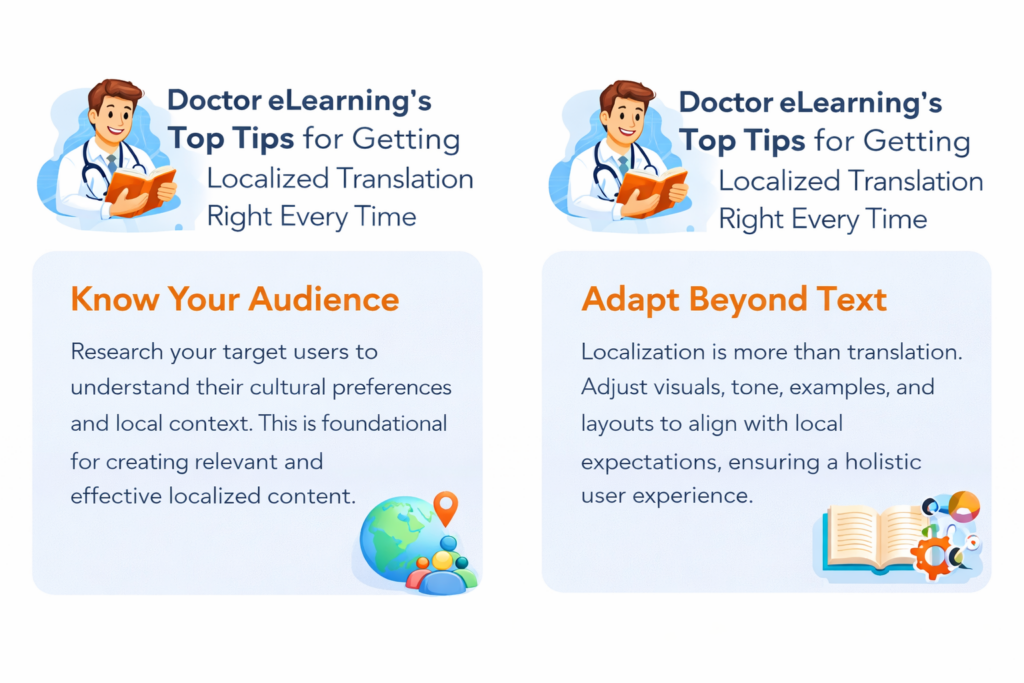
Doctor eLearning’s Top Tips for Getting Localize Translation Right Every Time
Transform the Way You Manage Translations
Choosing the right translation management software can feel overwhelming at first; however, focusing on a few reliable options can significantly simplify the process. Instead of testing every tool available, you should shortlist platforms that align with your workflow and budget, and then evaluate them based on features, usability, and performance. Moreover, modern solutions now offer AI-powered automation and seamless integrations, making multilingual content creation faster and more efficient than ever before. In addition, if you’re looking for a comprehensive and user-friendly solution, Doctor eLearning stands out by combining advanced translation capabilities with eLearning-focused features, helping you streamline your entire localization process. Therefore, taking advantage of free trials and hands-on testing will ultimately help you make a more confident and informed decision.
Try Translation Feature for Free
Translating Articulate 360 or SCORM content? Try Doctor eLearning free — upload your XLIFF or DOCX and get translated output in minutes.
FAQ
Q: Which free document translator is most accurate?
A: Free document translators can provide decent results; however, accuracy often varies and may lack context. Therefore, for reliable and consistent output, tools like Doctor eLearning offer a more accurate solution.
Q: Is Doctor eLearning free?
A: Yes — no credit card required to start.
Q: Can I translate confidential documents safely online?
A: While some free tools offer basic security, they may not guarantee full data protection; therefore, sensitive information can be at risk. In contrast, Doctor eLearning ensures a secure platform for safe document handling.
Q: What file formats are supported by free translators?
A: Free translators typically support formats like DOCX, PDF, and TXT; however, advanced formats are often limited. Moreover, Doctor eLearning supports additional formats like SCORM and XLIFF for better flexibility.
Conclusion: Good Translation Gets You There, Localization Gets You Everywhere
Throughout this guide, we have explored the best translation tools for eLearning in 2026, and one thing has become absolutely clear: the right tool can completely transform the way your business communicates with the world. In fact, the difference between a good eLearning experience and a great one often comes down to the quality of your translation. That is why Doctor eLearning stands above the rest, combining AI-powered accuracy, 130+ language support and seamless LMS integration into one powerful and easy-to-use platform.
