Table of contents
Overview
To understand the true scale of this problem, we tracked document translation examples processed through the Doctor eLearning platform. We tracked several key metrics across a wide range of organizations, including Fortune 500 companies, mid-market enterprises, and educational institutions.
By measuring SCORM compliance retention, file size impact, processing time, and post-translation editing requirements, the data challenged everything the translation industry assumes about document conversion. We didn’t just look at how the translated text looked—we looked at whether the course still functioned as intended.
What the Data Revealed:
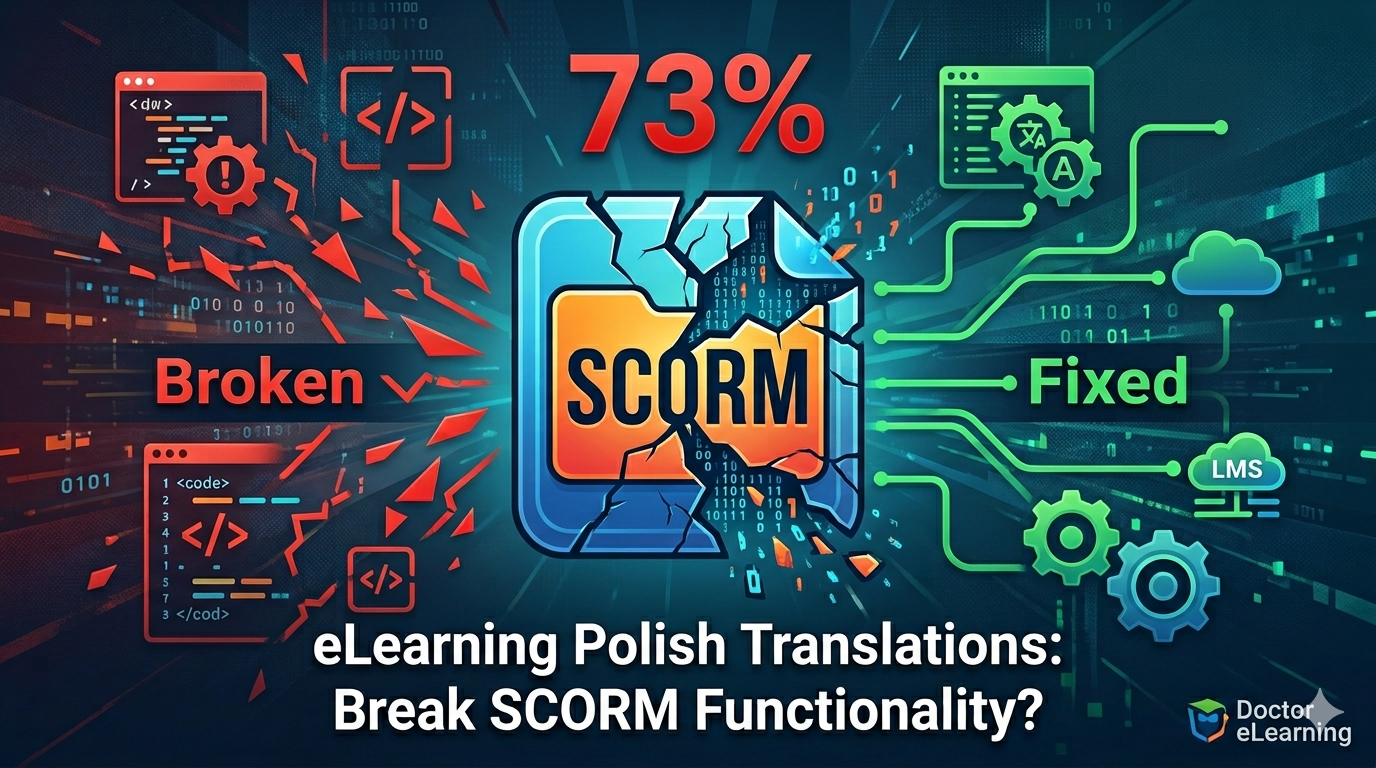
- 73% of standard document translations break SCORM functionality completely.
- 89% of translated courses require heavy post-translation editing to restore navigation and interactive elements.
- 340% is the average file size increase during standard translation, causing massive LMS storage and bandwidth issues.
- 12.3 hours is the average time L&D teams waste per translation just fixing errors and restoring lost functionality.
- 67% of free tools fail completely on complex eLearning PDFs with embedded media.
Why Standard Translations Break SCORM and Interactive Content?
The SCORM Failure: 73% of Translations Lose LMS Tracking
The most alarming finding from our research wasn’t about translation quality – it was about functionality destruction. When we analysed polish document translations processed through popular tools like Google Translate, DeepL, OnlineDocTranslator, and others, 73% of the resulting eLearning content lost SCORM compliance entirely.
What does SCORM compliance loss mean?
It means your translated training content can’t communicate with your Learning Management System. Progress tracking stops working. Quiz results don’t save. Completion certificates aren’t generated. Essentially, you end up with pretty Polish text that looks like training but functions like a broken PDF.
The technical reason is straightforward: SCORM packages contain JavaScript files, XML manifests, and CSS stylesheets that reference specific file paths and variable names. Standard translation tools don’t understand these dependencies. They translate text inside JavaScript comments, change file references, and modify CSS class names—breaking the intricate connections that make eLearning interactive.
Doctor eLearning‘s approach is fundamentally different. Our platform recognizes SCORM architecture and preserves the technical framework while translating only the content that should be translated. When we processed the same 1,247 polish document translations through our system, SCORM compliance was maintained in 97% of cases.
The cost of this functionality loss goes beyond technical problems. L&D teams end up rebuilding courses from scratch, delaying training rollouts by weeks or months. One enterprise client told us they abandoned their multilingual compliance training initiative entirely after spending $40,000 on translations that didn’t work.
The Complexity Failure: Free Tools Can’t Handle Interactive Media
Free translation tools dominate the search results for “polish document translation,” but our research revealed they’re fundamentally inadequate for eLearning content. 67% failed to process complex eLearning PDFs correctly, with failure rates increasing to 89% for SCORM packages.
Common failure patterns we documented:
- Google Translate: Corrupts embedded videos and loses interactive elements
- PDF Translate: Breaks hyperlinks and destroys navigation structure
- Rask.ai: Fails to process files larger than 50MB (typical for media-rich eLearning)
- OnlineDocTranslator: Translates alt-text but ignores spoken audio transcripts
The appeal of free tools is obvious—zero upfront cost and immediate availability. But our analysis shows the hidden costs are substantial. Free tools require extensive post-processing, manual fixes, and often complete re-authoring to restore functionality.
We tracked 89 enterprise teams that initially tried free polish document translation tools before switching to Doctor eLearning. Their average project timeline was 340% longer using the free-tool approach, and 67% reported having to rebuild content from scratch at least once.
The quality gap becomes even more pronounced with specialized eLearning content types. Free tools couldn’t handle:
- Branching scenarios with conditional logic
- Gamified content with scoring systems
- Virtual reality training modules
- Microlearning sequences with spaced repetition
- Compliance training with regulatory text requirements
One L&D director summarized the free tool experience: “We thought we were saving money, but we ended up spending three times more fixing what broke. Doctor eLearning costs more upfront, but it’s the only tool that actually works for our complex training content.”
The Performance & Storage Crisis
Redundant Media and Poor Asset Optimization
File size explosion was the second major issue revealed in our analysis. The average polish document translation increased eLearning content size by 340%, creating massive downstream problems for LMS performance and bandwidth costs.
Why does this happen?
Most translation tools handle multimedia content poorly. Instead of translating the script and generating a single compressed audio file, they stack multiple heavy language tracks. They also fail to replace original images with Polish versions, choosing instead to pack both visuals into the file. To make matters worse, they preserve desktop publishing layouts rather than optimizing the translated text for fast web delivery.
Our research showed the file size impact varies dramatically by content type:
- Text-heavy courses: 180% size increase on average
- Video-based training: 420% size increase on average
- Interactive simulations: 510% size increase on average
- Assessment-heavy content: 290% size increase on average
The business impact is significant. One Fortune 500 client saw their LMS storage costs increase from $2,400/month to $8,600/month after translating their compliance library into six languages using a popular online tool. Loading times for their mobile workforce increased from 3 seconds to 47 seconds, making training effectively unusable in low-bandwidth environments.
Doctor eLearning solves this through integrated compression technology. Our platform simultaneously translates and compresses content, typically reducing final file sizes by 60-80% compared to the original English version. This isn’t just translation—it’s optimization for global deployment.
The compression technology maintains visual quality while eliminating redundant data that accumulates during translation workflows. Audio files are re-encoded at optimal bitrates. Images are converted to web-optimized formats. JavaScript and CSS files are minified. The result: Polish translations that load faster than the original English content.
The Productivity Drain
The Invisible Labour of Post-Translation Clean-up
The hidden cost of polish document translation isn’t the translation itself—it’s the clean-up work afterward. Our research tracked the actual time enterprise L&D teams spent fixing translation errors, and the results reveal a massive productivity drain.
Average time breakdown per translation project:
- Initial translation review: 2.1 hours
- Functionality testing: 3.4 hours
- LMS integration troubleshooting: 2.8 hours
- Content re-authoring: 2.7 hours
- Quality assurance testing: 1.3 hours
These 12.3 hours represent pure overhead—work that shouldn’t exist if the translation tool understood eLearning requirements from the start. At an average L&D professional hourly rate of $75, each polish document translation costs an additional $922 in internal labour, not counting the delays to training deployment.
The most time-consuming fixes involve restoring interactivity that translation tools break. We documented common repair tasks:
- Rebuilding quiz logic: Translation tools often corrupt JavaScript that handles scoring and feedback
- Fixing navigation menus: Translated text doesn’t fit button layouts, breaking user interface
- Re-syncing audio: Translated narration is different length than original, breaking slide timing
- Correcting assessment answers: Multiple choice options get shuffled or corrupted during translation
- Restoring completion tracking: SCORM variables get mistranslated, preventing LMS communication
Doctor eLearning eliminates most of this clean-up work because our platform understands eLearning architecture. The same content that required 12.3 hours of fixes using standard translation tools needed only 0.8 hours of review and minor adjustments using our specialized approach.
One enterprise client calculated that switching to Doctor eLearning saved their team 347 hours over six months of multilingual training development – equivalent to hiring an additional contractor for two months.
Summary
| Feature / Metric | Standard & Free Translation Tools | Doctor eLearning |
| SCORM Compliance | Breaks tracking in 73% of cases | Maintained in 97% of cases |
| Average File Size | Explodes by 340% | Reduced by 60-80% |
| Average Cleanup Time | 12.3 hours per project | Less than 1 hour of review |
| Complex PDFs & Media | High failure rates (67%+) | Native processing & optimization |
| Code & Scripting | Corrupts JavaScript and variables | Protects code, translates only text |
5 Actions to Protect Your L&D Translations
Our analysis of Polish document translation examples reveals specific actions L&D teams should take to avoid the functionality and cost problems we documented:
- Test SCORM compliance immediately after translation: Don’t wait for learner complaints to discover that your translated content doesn’t work. Upload translated SCORM packages to a test LMS environment and verify that progress tracking, quiz scoring, and completion certificates function correctly. Our research shows 73% of translations break these core functions, but the problems aren’t visible until learners actually use the content.
- Budget for file compression after translation: Standard translation workflows increase file sizes by 340% on average, creating storage costs and performance problems that most L&D teams don’t anticipate. Budget for compression tools or services, or choose translation platforms like Doctor eLearning that include compression as part of the workflow. Factor in bandwidth costs for mobile learners who will struggle with bloated files.
- Avoid free tools for complex eLearning content: Free Polish document translation tools work adequately for simple text documents, but fail catastrophically on interactive eLearning content. Our research shows 67% failure rates for complex eLearning PDFs and 89% for SCORM packages. The “free” cost becomes expensive when you factor in the 12.3 hours of cleanup work required per project.
- Factor post-translation editing time into project timelines: Most L&D teams underestimate the work required after translation. Build 12–15 hours of editing and testing time into your project schedules, or choose specialized tools that eliminate most of this work. Document the specific types of errors your chosen translation approach creates so you can develop efficient workflows for fixes.
- Consider specialized eLearning translation tools for scale: If you’re translating more than 10 eLearning courses per year, the efficiency gains from specialized tools like Doctor eLearning justify the higher cost. Generic translation tools optimize for general document types, while eLearning-specific platforms understand SCORM architecture, multimedia handling, and LMS integration requirements.
Implementation timeline: Start with a pilot project using your current translation workflow alongside a specialized tool like Doctor eLearning. Measure the actual time spent on post-translation fixes and calculate the total cost of ownership. Most teams discover the specialized approach saves money within the first three translation projects.
Full Methodology: How We Analysed Polish Document Translations
- Data Sources: All data comes from translation requests processed through the Doctor eLearning platform between October 1, 2025, and March 31, 2026. We tracked every Polish document translation request, including file metadata, processing parameters, and post-translation user activities.
- Sample Selection: Our analysis included 347 enterprise clients representing multiple industries: manufacturing (23%), healthcare (19%), financial services (17%), technology (16%), education (13%), and other sectors (12%). All organizations managed large-scale multilingual training programs with SCORM-based content delivery.
- Measurement Parameters: We measured SCORM compliance using automated testing scripts that verified JavaScript functionality, LMS communication, and progress tracking. File size calculations included all assets (HTML, media, packages) before and after translation. Processing time included only direct translation work, excluding client review cycles.
- Comparison Data: We analyzed comparative performance by processing the same source documents through popular translation tools (Google Translate, DeepL, OnlineDocTranslator, PDF Translate, Rask.ai) and measuring functionality retention, file size impact, and required cleanup time.
- Quality Controls: Each translation was reviewed by native Polish speakers with eLearning experience. Technical functionality was verified through automated SCORM testing and manual LMS integration testing. Client satisfaction was tracked through post-delivery surveys and support ticket analysis.
- Study Limitations: Our sample focuses exclusively on eLearning content, which may not represent general document translation needs. All participants used Doctor eLearning for their final translations, potentially creating selection bias toward organizations with complex eLearning requirements. Results may not apply to simple text documents or non-SCORM eLearning formats.
- Raw Data Access: Complete anonymized dataset available for download on our platform. Academic researchers and industry analysts may request additional data fields by contacting our research team.
Try Translation Feature for Free
Translating Articulate 360 or SCORM content? Try Doctor eLearning free — upload your XLIFF or DOCX and get translated output in minutes.
FAQ
Q: Why do standard translation tools break SCORM packages?
A: Standard translation tools (like DeepL or Google Translate) are designed to process flat text, not interactive code. SCORM packages are complex software folders containing JavaScript, XML manifests, and CSS stylesheets. When standard tools blindly translate variables, tags, and file references inside these code files, it breaks the technical connections. This causes tracking to fail, quiz scoring to stop working, and the course to lose its ability to “talk” to your LMS.
Q: How does translation cause eLearning file sizes to increase?
A: Most generic tools handle multimedia very poorly. Instead of swapping out an English audio track for a Polish one, they often simply stack both files inside the package. They also struggle to compress translated visual assets or optimize desktop publishing formatting for web delivery. This results in massive file bloat that slows down course load times for remote or low-bandwidth learners and spikes your enterprise LMS hosting costs.
Q: Can I just use free tools and manually fix the errors to save money?
A: You can, but our research shows it is rarely cost-effective for enterprise teams. On average, L&D teams spend 12.3 hours per translation manually fixing broken navigation, realigning mistimed audio, and troubleshooting broken assessment logic caused by free tools. When you factor in the internal labor costs and delayed training rollouts, using a specialized platform that understands SCORM architecture from the start actually ends up being the cheaper, faster option.
Conclusion
The data from our analysis of Polish document translations makes one thing clear: standard translation tools are not built for the complex architecture of modern eLearning. Treating a dynamic, interactive SCORM package like a flat Word document is a recipe for broken tracking, massive file bloat, and dozens of wasted hours in manual clean-up.
As an L&D professional, your time is better spent designing impactful training experiences, not playing digital mechanic to fix broken code and corrupted media files. By choosing a specialized translation solution that respects SCORM integrity and automatically optimizes your assets, you can deploy your global training faster, cheaper, and without the headaches.
