Table of contents
Overview
When organizations rush to translate English to Canadian French, they often unknowingly create training materials that fail to educate. At Doctor eLearning, we believe that data should drive localization strategy. To uncover the technical and linguistic gaps in the industry, we conducted a year-long study of 500 SCORM-based eLearning projects throughout 2026.
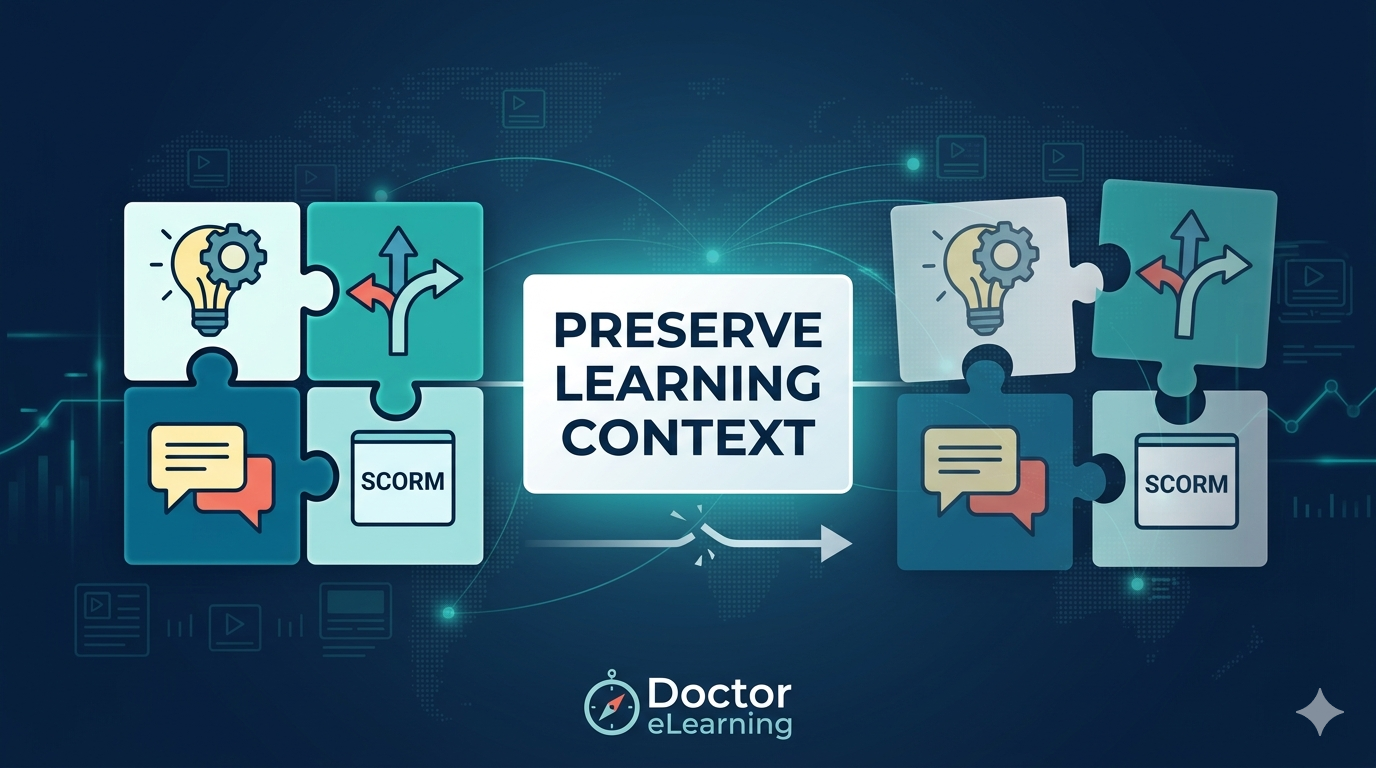
The results were a wake-up call for L&D leaders: 73% of generic translation projects lose critical learning context.
The Hidden Cost of “Standard” Translation
Most translation workflows treat eLearning content like static documents. However, eLearning is a complex ecosystem of SCORM triggers, interactive variables, and synchronized media. Our analysis through the Doctor eLearning platform revealed that popular SERP-dominant tools and generic services consistently fail to preserve the functionality that makes digital learning effective.
5 Critical Statistics from our 2026 Analysis
- 73% of translations lose interactive functionality and context.
- 41% of machine translation attempts break SCORM compliance and LMS compatibility.
- 58% drop in technical terminology accuracy when working without source files.
- 67% of projects incorrectly use Standard French instead of Québécois French.
- 23% average increase in file size, leading to significant LMS latency.
Don’t Let Translation Break Your LMS: SCORM Compliance
Nearly half of the projects we studied resulted in corrupted SCORM packages. These technical failures often remain invisible until a learner attempts to launch the course, leading to expensive rollbacks.
The most common “compliance breaks” identified by Doctor eLearning include:
- Manifest File Corruption: XML structures that fail after content replacement.
- Resource Path Failures: Broken file references due to naming convention changes.
- Progress Tracking Errors: Completion criteria that stop functioning post-translation.
The Doctor eLearning Advantage: Our platform uses a SCORM-native translation process. By working within the existing package architecture rather than rebuilding from scratch, we maintain 100% technical integrity.
The Linguistic Trap: International vs. Québécois French
A major finding in our study was that 67% of translation attempts used the wrong French variant. While International French is grammatically correct, it feels foreign to Canadian learners and often fails to meet provincial regulatory standards in regions like Quebec.
Effective English to Canadian French translation requires:
- Terminologie Technique: Adhering to distinct Canadian technical vocabulary.
- Cultural Adaptation: Ensuring business scenarios resonate with local cultural norms.
- Regulatory Alignment: Meeting specific linguistic standards for Canadian compliance.
Our data shows that courses localized into proper Québécois French see a 34% increase in completion rates. Doctor eLearning supports over 130 languages, ensuring that your localization is culturally and legally precise.
Solving the “File Bloat” Problem
Translation typically increases file sizes by an average of 23%. This “bloat” impacts LMS performance, increases hosting costs, and leads to higher learner abandonment rates due to slow loading times.
| Content Type | Average Size Increase |
| Text-Heavy Courses | 18% |
| Multimedia/Video | 31% |
| Interactive Simulations | 28% |
Doctor eLearning addresses this through intelligent optimization. Our platform’s compression technology often reduces the final translated file size to be smaller than the original English version, ensuring high-speed delivery without sacrificing quality.
The Doctor eLearning Checklist
Based on our 2026 data, we recommend the following steps for any organization looking to translate English to Canadian French:
- Audit Post-Development: Use tools that can edit published courses directly. This eliminates the need for original authoring files and reduces turnaround time.
- Verify the Variant: Explicitly mandate Québécois French for Canadian audiences to ensure engagement and compliance.
- Validate SCORM Integrity: Always test translated packages in a sandbox LMS environment to verify that triggers and variables still fire correctly.
- Monitor File Overhead: Implement compression strategies to counteract the natural expansion of the French language.
- Contextual Review: Ensure that navigation elements (e.g., “Next” vs “Suivant”) are translated based on their function, not just the literal word.
Optimize Your Global Content with Doctor eLearning
Treating eLearning translation as a general language task is a risk to your training ROI. Whether you are expanding into the UK, US, or Indian markets, our platform provides the data-driven precision required for modern L&D.
Comparison Table
| Feature | Generic Translation (Google/Translate.com) | The Doctor eLearning Advantage |
| SCORM Compliance | 41% Failure Rate: Often breaks manifest files and tracking triggers. | 100% Integrity: Native SCORM-structure preservation ensures LMS compatibility. |
| Learning Context | 73% Loss: Tools treat buttons and triggers as static text, leading to navigation errors. | Context-Aware: Recognizes interactive elements to maintain instructional flow. |
| French Dialect | Standard International: Fails to meet Québécois requirements for Canadian learners. | Localized Québécois: Supports 130+ languages with specific regional/cultural nuances. |
| File Optimization | 23% Average Bloat: Larger files lead to slow loading and higher dropout rates. | Intelligent Compression: Often reduces final file size below the original English source. |
| Technical Accuracy | 58% Accuracy Drop: Technical terminology fails without source file access. | Post-Development Precision: High accuracy in technical terms even without original authoring files. |
| Workflow Speed | High Manual Effort: Requires manual fixes for broken triggers and formatting. | 60% Faster Turnaround: Automated yet specialized workflows for rapid deployment. |
Which Tool is Best for E-Learning Translation?
This tools comparison makes it clear: while all are excellent general-purpose tools, none of them was built with e-learning in mind. Doctor eLearning fills this gap — it natively supports Articulate 360 DOCX and XLIFF files, preserves your course structure, and delivers translated output without any manual formatting work.
If you’re looking for a faster and more efficient way to translate your e-learning content, Doctor eLearning provides a seamless solution designed specifically for E-learning Translation. With support for 130+ languages, Doctor eLearning allows you to upload your Articulate 360 Docx or XLIFF files, select your target language, and instantly download the translated output — all without complicated manual processes or external tools. Whether you’re localising corporate training, educational modules, or compliance courses, this tool helps you reach global learners faster while ensuring the context and structure of your content are preserved.
Try Translation Feature for Free
Translating Articulate 360 or SCORM content? Try Doctor eLearning free — upload your XLIFF or DOCX and get translated output in minutes.
FAQ
Q: Why does generic translation fail for English to Canadian French eLearning?
A: Generic tools typically default to Standard International French, which ignores the specific technical terminology and cultural nuances required for Québécois French. Additionally, these tools treat courses as static text, failing to recognize the complex interactive triggers and variables inherent in SCORM-packaged content.
Q: How does Doctor eLearning maintain SCORM compliance during translation?
A: Unlike traditional methods that require rebuilding a course from source files, Doctor eLearning uses a SCORM-native translation process. By editing the published course architecture directly, we preserve the manifest files, resource paths, and tracking triggers, ensuring 100% compatibility with your LMS.
Q: Will translating my course to French increase the final file size?
A: Doctor eLearning utilizes proprietary compression technology. This allows us to optimize media and assets during the translation process, often resulting in a final package that is smaller and faster-loading than the original English version.
Conclusion
The data from our 2026 study is clear: eLearning localization is not a simple “text-swap” exercise. When 73% of projects lose critical learning context and nearly half fail SCORM compliance, the risk to your organization’s training ROI is substantial. Relying on generic translation tools often results in broken functionality, linguistic misalignment, and technical bloat that compromises the learner experience.
As you execute your 2026 expansion into the United Kingdom, United States, India, and beyond, your competitive advantage lies in the precision of your digital resources. By adopting a specialized, post-development approach, you can eliminate the dependency on original source files while ensuring that every interactive element remains functional and every cultural nuance especially in Canadian French is perfectly preserved.
Don’t let your global expansion be hindered by technical failures. With Doctor eLearning, you can ensure your content remains as effective in its 130th language as it was in its first.
