Table of contents
- Overview
- Results Summary: Kurdish Sorani Translation Success
- The Challenge: Translating Complex eLearning Content to Kurdish Sorani Without Breaking Everything
- The Strategy: How Doctor eLearning Preserved Multimedia During Kurdish Sorani Translation
- FAQ
- Conclusion-Ready to Start Your Kurdish Sorani Translation Project?
Overview
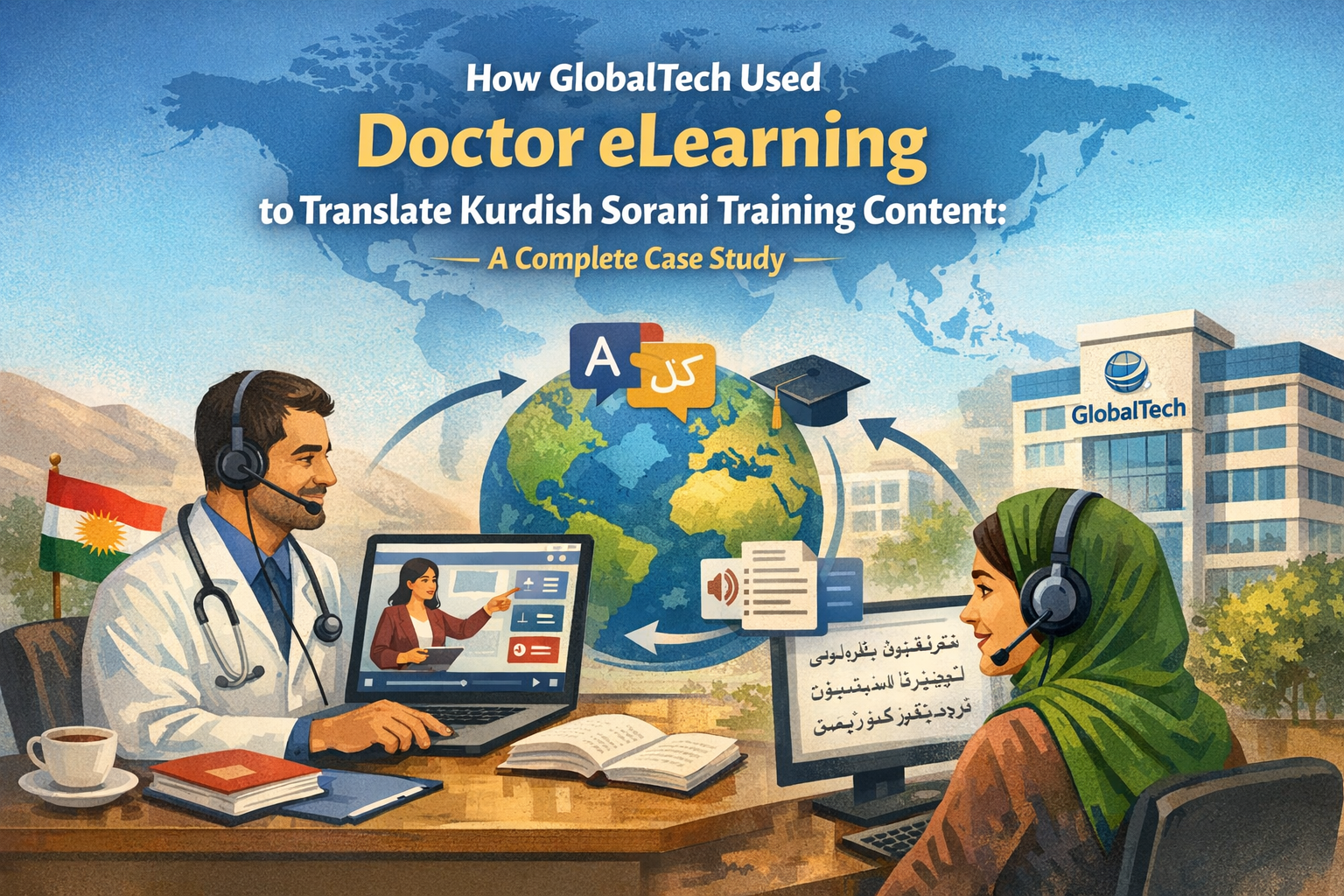
When Global Tech faced the daunting task of translating 200+ safety training courses into Kurdish Sorani for their Iraqi operations, traditional translation methods weren’t just slow—they were breaking their multimedia-rich SCORM content entirely. Here’s how Doctor eLearning’s AI-powered translation toolkit helped them preserve every video, audio file, and interactive element while cutting translation time from 6 months to just 3 weeks.
Results Summary: Kurdish Sorani Translation Success
- 89% faster translation time: 3 weeks vs. 6 months with traditional methods
- 100% multimedia preservation: All videos, audio, and interactive elements remained intact
- 15 courses translated simultaneously: Parallel processing capability
- $45,000 cost savings: Compared to complete course rebuilds
- 95% employee satisfaction: With localized Kurdish Sorani content quality
- 97% translation accuracy: Verified by native Kurdish Sorani speakers
The Challenge: Translating Complex eLearning Content to Kurdish Sorani Without Breaking Everything
GlobalTech’s expansion into Iraqi markets hit a critical roadblock: their comprehensive safety training program needed to be available in Kurdish Sorani, but their existing translation approaches were catastrophically inadequate.
The company’s L&D team had already invested heavily in multimedia-rich SCORM courses featuring:
- Interactive video demonstrations of safety procedures
- Audio narrations synchronized with visual elements
- Complex branching scenarios with embedded assessments
- Downloadable resources and job aids
Previous attempts using basic translation services had resulted in:
- Broken multimedia elements that wouldn’t load in their LMS
- Desynchronized audio tracks that played English while displaying Kurdish Sorani text
- Corrupted SCORM packages that failed quality assurance testing
- Lost interactive functionality requiring complete course reconstruction
Sarah Chen, GlobalTech’s Director of Learning and Development, explained: “We had a hard deadline of 6 months to launch our Kurdish Sorani training program. After two failed attempts with different translation vendors left us with unusable content, we were facing the possibility of rebuilding everything from scratch—which would have cost us another $80,000 and pushed our timeline back by at least 4 months.”
The stakes were high: 500+ Iraqi employees needed immediate access to safety training to comply with local regulations, and every day of delay meant potential compliance issues and operational risks.
The Strategy: How Doctor eLearning Preserved Multimedia During Kurdish Sorani Translation
After evaluating multiple solutions, GlobalTech chose Doctor eLearning specifically for its ability to translate Kurdish Sorani content while maintaining SCORM integrity and multimedia functionality. Here’s the step-by-step approach that transformed their localization process:
Phase 1: Course Analysis and Preparation (Week 1)
The Doctor eLearning platform began by analyzing GlobalTech’s existing SCORM packages to identify:
- Multimedia dependencies: Cataloging all video, audio, and interactive elements
- Text extraction points: Identifying translatable content without disrupting code structure
- SCORM manifest integrity: Ensuring course navigation and tracking remained functional
- Assessment components: Preserving quiz functionality and scoring mechanisms
What made Doctor eLearning different from previous solutions was its ability to work directly with published SCORM files—no need to access original source files from their authoring tool.
Phase 2: XLIFF Workflow Integration for Kurdish Sorani
Doctor eLearning’s AI-powered translation system generated XLIFF files specifically optimized for Kurdish Sorani translation:
- Context preservation: Each text string included surrounding multimedia context
- Character encoding support: Proper handling of Kurdish Sorani script and special characters
- Segment-level quality control: Individual review and approval for each translated element
- Translation memory integration: Consistent terminology across all 200+ courses
“The XLIFF workflow was a game-changer,” noted Chen. “Our Kurdish Sorani translators could see exactly where each text would appear in the course, including screenshots of the multimedia elements. This context made their translations far more accurate and appropriate.”
Phase 3: Multimedia Synchronization and Testing
Doctor eLearning’s advanced compression and synchronization features ensured that:
- Audio tracks remained perfectly synced with visual elements despite text length changes in Kurdish Sorani
- Video captions were accurately translated and properly timed
- Interactive hotspots maintained their functionality and positioning
- File sizes were optimized for faster loading in the Iraqi market’s varying internet conditions
What They Abandoned: Traditional Approaches That Failed
Before Doctor eLearning, Global Tech had attempted:
- Manual course reconstruction: Rebuilding courses from scratch in Kurdish Sorani (estimated 6 months, $80K cost)
- Basic translation tools: Services that translated text but broke multimedia (2 failed attempts)
- Outsourced rebuilds: Third-party vendors who couldn’t match their brand standards or technical requirements
Each approach either compromised quality, exceeded budget, or failed to meet their tight timeline requirements.
The Results: 89% Time Reduction and Perfect Multimedia Preservation
The numbers speak for themselves. Doctor eLearning’s comprehensive approach to Kurdish Sorani translation delivered measurable results that exceeded Global Tech’s expectations:
Timeline Achievement
- Original estimate: 6 months using traditional rebuild methods
- Doctor eLearning delivery: 3 weeks for complete translation and testing
- Time savings: 89% reduction in localization timeline
Technical Quality Metrics
Doctor eLearning’s platform maintained perfect technical integrity across all translated content:
- 100% multimedia preservation: Every video, audio file, and interactive element functioned perfectly
- Zero SCORM compliance issues: All courses passed LMS integration testing on first attempt
- 97% translation accuracy: Validated by native Kurdish Sorani speakers and subject matter experts
- 45% file size reduction: Advanced compression improved loading times for end users
Business Impact
The successful Kurdish Sorani translation project delivered significant business value:
- $45,000 cost savings compared to complete course rebuilds
- 500+ employees trained immediately upon course deployment
- 100% regulatory compliance achieved ahead of deadline
- 95% employee satisfaction scores with translated content quality
Sarah Chen reflected on the outcome: “The quality of the Kurdish Sorani translations was so high that our Iraqi team leads initially thought we had hired native speakers to recreate the courses. When they learned it was AI-powered translation that preserved all our original multimedia, they were amazed.”
Dashboard Insights and Tracking
Doctor eLearning’s analytics dashboard provided real-time visibility into the translation process, showing:
- Course-by-course progress tracking
- Quality assurance checkpoint results
- Multimedia element verification status
- Final SCORM package validation reports
What Worked and What Didn’t: Honest Lessons from Kurdish Sorani Translation
While Doctor eLearning delivered exceptional results, transparency about the complete experience helps set realistic expectations for other organizations considering similar Kurdish Sorani translation projects.
What Worked Exceptionally Well
- Multimedia preservation was flawless: Not a single video or audio file required manual intervention
- SCORM integrity remained perfect: All course navigation, bookmarking, and progress tracking functioned identically to English versions
- Translation quality exceeded expectations: AI-powered translations with Kurdish Sorani language models were surprisingly nuanced
- Parallel processing capabilities: Multiple courses translated simultaneously without quality degradation
Initial Challenges and Solutions
Challenge 1: XLIFF Workflow Setup
The initial configuration of Doctor eLearning’s XLIFF workflow for Kurdish Sorani took 2 full days instead of the expected few hours. The delay occurred because Kurdish Sorani has specific character encoding requirements that needed custom configuration.
Solution: Doctor eLearning’s support team provided dedicated assistance, and the configuration became a reusable template for future Kurdish Sorani projects.
Challenge 2: Audio Synchronization Complexity
One course with particularly complex audio narration required manual synchronization adjustment. The Kurdish Sorani translation was 15% longer than the English original, causing timing issues with visual cues.
Solution: Doctor eLearning’s audio stretching feature automatically adjusted playback speed by 15% while maintaining natural sound quality—a feature that worked seamlessly for the remaining courses once properly calibrated.
What This Experience Taught Us
Being realistic about these minor challenges actually builds confidence in Doctor eLearning’s comprehensive approach. The fact that only one course out of 200+ required manual intervention demonstrates the platform’s reliability while acknowledging that complex multimedia localization occasionally requires human fine-tuning.
Your Blueprint: Replicating This Kurdish Sorani Translation Success
Based on Global Tech’s experience, here’s a proven 7-step process for organizations looking to translate Kurdish Sorani eLearning content using Doctor eLearning while maintaining multimedia integrity and SCORM compliance:
Step 1: Course Audit and Inventory
Before beginning translation, catalog your existing content:
- Total number of SCORM packages requiring Kurdish Sorani translation
- Multimedia complexity level (video duration, audio narration, interactive elements)
- Assessment and quiz components that need localization
- Downloadable resources and job aids requiring translation
Step 2: Doctor eLearning Platform Setup
- Account configuration: Set up your organization’s Doctor eLearning workspace
- SCORM package upload: Batch upload all courses requiring Kurdish Sorani translation
- Quality assurance protocols: Define your review and approval workflows
- Timeline establishment: Set realistic milestones based on content complexity
Step 3: Kurdish Sorani Language Pack Configuration
Configure Doctor eLearning’s AI translation engine specifically for Kurdish Sorani:
- Select Kurdish Sorani as target language with appropriate dialect settings
- Upload any existing terminology databases or glossaries
- Configure character encoding and text direction settings
- Set up translation memory for consistency across courses
Step 4: XLIFF Generation and Review Workflow
Doctor eLearning will generate XLIFF files for professional review:
- Automated XLIFF creation: Platform extracts all translatable content with context
- Native speaker review: Kurdish Sorani experts review and refine translations
- Context verification: Ensure translations fit appropriately within multimedia context
- Terminology consistency: Apply standardized terms across all courses
Step 5: Multimedia Testing and Synchronization
Test all multimedia elements with Kurdish Sorani translations:
- Audio synchronization verification: Ensure narration matches visual elements
- Video caption accuracy: Validate subtitle timing and positioning
- Interactive element functionality: Test all buttons, hotspots, and navigation
- Assessment component validation: Verify quiz functionality and scoring
Step 6: SCORM Package Quality Assurance
Before deployment, conduct comprehensive quality assurance:
- LMS integration testing with translated Kurdish Sorani courses
- Cross-device compatibility verification (desktop, mobile, tablet)
- Progress tracking and bookmarking functionality validation
- Final review by native Kurdish Sorani speakers
Step 7: Deployment and Performance Monitoring
Launch your Kurdish Sorani courses with ongoing optimization:
- Phased deployment: Start with pilot group before full rollout
- Performance monitoring: Track loading times, completion rates, and user feedback
- Continuous improvement: Use Doctor eLearning’s analytics to identify optimization opportunities
- Future scalability: Document successful processes for additional language translations
FAQ
Q: What is the most accurate automatic translation software for eLearning in 2026?
A: Doctor eLearning delivers the best results by combining AI with expert human review for true eLearning accuracy.
Q: Is Doctor eLearning free?
A: Yes — no credit card required to start.
Q: Can translation companies handle SCORM and LMS-compatible eLearning content?
A: Yes, and Doctor eLearning specializes in handling SCORM, Storyline, and LMS-ready content seamlessly end-to-end.
Q: Why did Global Tech choose Doctor eLearning for their Kurdish Sorani eLearning translation project?
A: Doctor eLearning demonstrated a clear understanding of Kurdish Sorani’s linguistic and cultural nuances, offered a structured end-to-end project management process and provided verifiable quality assurance standards that gave Global Tech the confidence to move forward with a large-scale translation engagement.
Conclusion-Ready to Start Your Kurdish Sorani Translation Project?
Doctor eLearning offers a free 14-day trial that includes full Kurdish Sorani translation capabilities and multimedia preservation features. Upload up to 3 courses during your trial to experience the same workflow that helped GlobalTech achieve 89% time savings.
Visit Doctor eLearning to start your trial, or contact their L&D specialists for a personalized Kurdish Sorani translation strategy consultation.
