Table of contents
Overview
In an era where digital borders are dissolving, the ability to communicate across cultures is no longer a luxury—it is a competitive necessity. As of 2026, over 75% of global consumers prefer to buy products in their native language. To capture this market, businesses must move beyond simple translation and master the nuances of comprehensive localization.
What is Translation? Definition and Core Principles
Translation is the process of converting text or speech from one language (the source) into another (the target) while maintaining the original meaning. It is primarily a linguistic exercise focused on accuracy and syntax.
Types of Translation Services
- Machine Translation (MT): Automated tools like Google Translate or DeepL for high-speed, low-cost drafts.
- Human Translation: Professional linguists ensuring nuance and grammatical perfection.
- Technical Translation: Specialized conversion of manuals, patents, or medical documents where terminology is rigid.
When Translation is the Right Choice
Translation is ideal for content where the context is universal and the primary goal is information transfer.
- Legal Documents: Contracts where literal accuracy is legally required.
- Internal Communications: Memos or company-wide announcements.
- Technical Documentation: Assembly instructions or data sheets.
What is Localization? Beyond Language Translation
Localization (L10n) goes several steps beyond translation. It involves adapting a product, service, or piece of content to a specific target market’s cultural, functional, and legal expectations.
Cultural Adaptation and Market-Specific Customization
Localization addresses the “feel” of the content. This includes:
- Visuals: Changing images to reflect local demographics.
- Symbols & Colors: Adjusting palettes to avoid cultural taboos.
- Idioms & Humour: Replacing metaphors to ensure they resonate locally.
Technical Localization and User Experience
Functional elements are adjusted to ensure the user experience is seamless, including date formats, currency, and UI/UX layouts (adjusting for text expansion or right-to-left scripts).
- Date/Time Formats: Switching between MM/DD/YY and DD/MM/YY.
- Currency & Units: Converting USD to EUR or pounds to kilograms.
- UI/UX Layout: Adjusting for text expansion (German text is often 30% longer than English) or right-to-left (RTL) scripts like Arabic.
Translation vs. Localization: Key Differences and Use Cases
While both involve language, they serve entirely different business functions. Understanding this distinction is the first step toward global dominance.
- Translation (The “What”): A literal, linguistic conversion of text. It focuses on grammar and syntax. It is a commodity.
- Localization (The “How”): A cultural and technical adaptation. It modifies images, UI layouts, and interactive elements to ensure the product feels “native.
The Use Case Reality: If you are translating a static PDF of safety regulations, standard translation works. However, if you are launching a global training program or an interactive app, simple translation will fail. This is where Doctor eLearning excels—it treats your content as a functional experience, not just a string of words.
Cost Analysis: Translation vs. Localization Investment
In 2026, looking at “price per word” is a trap. The true cost of a project includes the technical debt of rebuilding assets.
| Cost Factor | Traditional Translation | Manual Localization | Doctor eLearning |
| Upfront Cost | Low | High | Medium (Optimized) |
| Technical Labor | Minimal | High (Requires devs) | Zero (No Source Needed) |
| Time-to-Market | 1–2 Weeks | 6–8 Weeks | 24–48 Hours |
| Long-term ROI | Low (Low engagement) | High | Maximum (High Speed/Engagement) |
The Doctor eLearning Advantage: While manual localization usually requires hiring expensive developers to open source files, Doctor eLearning allows you to localize published SCORM packages directly. You save thousands in engineering hours.
Translation vs. Localization: Side-by-Side Comparison
To scale in 2026, you need a partner that understands the technical architecture of your content.
| Feature | Standard Translation | Traditional Localization | Doctor eLearning |
| Focus | Text Accuracy | Cultural Nuance | Speed + Technical Integrity |
| Visual Assets | Ignored | Manual Re-design | Instant Media Swapping |
| File Handling | Word/Excel | Complex Source Files | Direct SCORM/XLIFF Edit |
| UX Layout | Often breaks UI | Manual adjustment | Auto-adaptive Formatting |
Decision Framework: Choosing the Right Approach
Use this 2026 framework to determine where to allocate your budget.
- Is the content internal and purely informational?
- Choice: Standard Translation.
- Is the content a high-touch brand experience or customer-facing app?
- Choice: Full Localization.
- Is the content a SCORM-based training module or interactive media that needs to launch in 10+ languages yesterday?
- Choice: Doctor eLearning.
Why Doctor eLearning Wins the Framework: Most businesses realize too late that they’ve lost their original source code or that their localized text is too “long” for the screen. Doctor eLearning is the only tool that solves these problems after the content is built, allowing for a 60% faster rollout than any agency or manual process.
Industry-Specific Applications: The Strategic Edge
In retail and SaaS, localization is non-negotiable. However, in Training and Development (L&D), standard translation often fails because interactive media is difficult to update.
Why Doctor eLearning is the Best Choice for Global Success
When businesses scale, they hit a “technical wall” with traditional agencies. Doctor eLearning is specifically engineered to tear that wall down. Here is why it is the industry-leading tool:
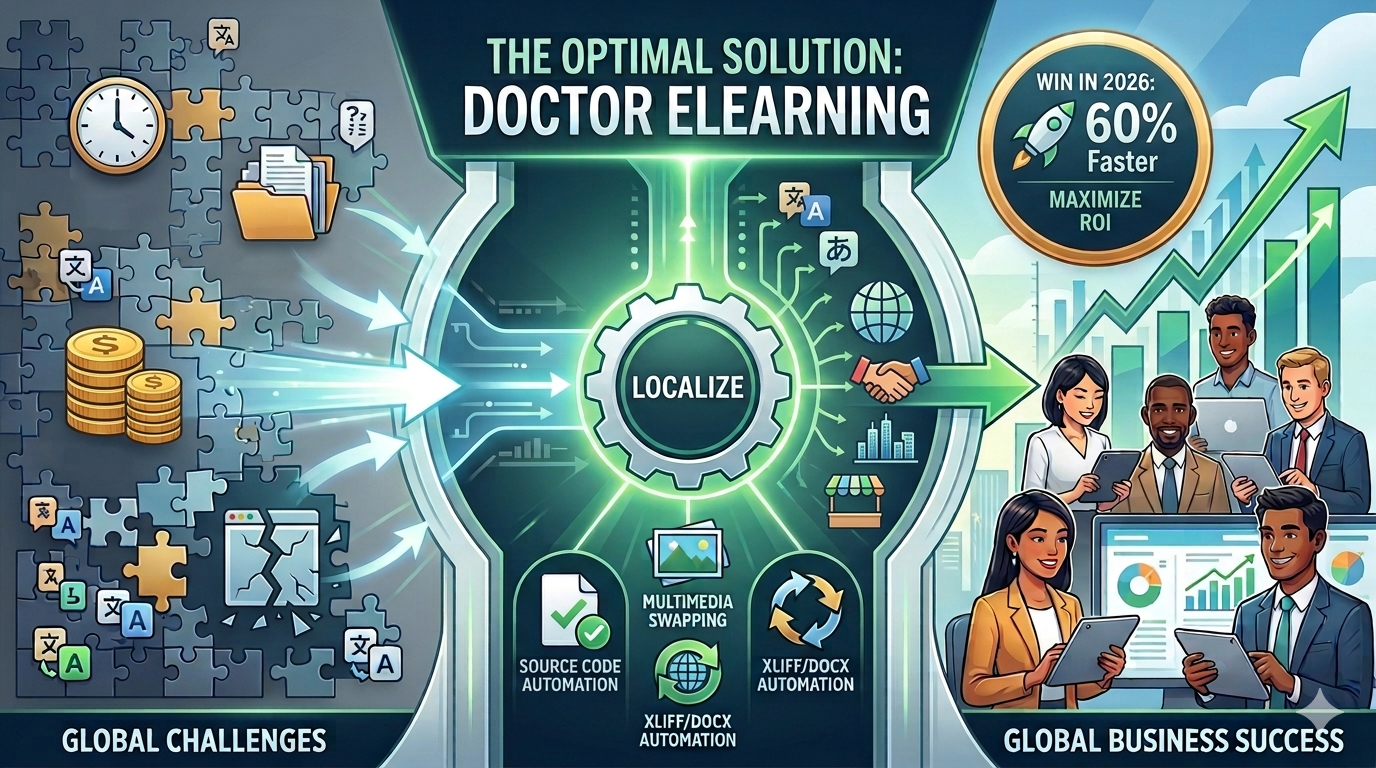
- No Source Code Needed: Unlike traditional agencies that require original, often lost, project files, Doctor eLearning allows you to edit and translate published SCORM packages directly.
- Multimedia Swapping: Effortlessly replace images or videos to fit local cultures without the need to rebuild the entire course from scratch.
- SCORM Compression: It optimizes your localized courses, ensuring they run smoothly on global LMS platforms, even in regions with lower bandwidth.
- Unmatched Efficiency: By automating the XLIFF/DOCX workflow, it reduces localization time by up to 60% compared to manual re-authoring.
Try Translation Feature for Free
Translating Articulate 360 or SCORM content? Try Doctor eLearning free — upload your XLIFF or DOCX and get translated output in minutes.
FAQ
Q: How much does localization cost compared to translation?
A: Localization typically costs 20% to 50% more due to the involvement of designers and testers. However, Doctor eLearning bridges this gap by automating the technical side, giving you premium localization at a fraction of the traditional cost.
Q: Is Doctor eLearning free?
A: Yes — no credit card required to start.
Q: What industries benefit most?
A: E-commerce, Gaming, SaaS, and eLearning. In these fields, user engagement is the primary driver of success—making localization the smartest investment you can make.
Q: How long does a typical localization project take?
A: In 2026, the timeline for a localization project depends entirely on whether you are using traditional manual workflows or modern automated platforms like Doctor eLearning.
While a standard 10,000-word project typically takes roughly 7 business days through traditional agencies, industry benchmarks show a drastic shift toward “Continuous Localization,” where updates happen in real-time.
| Project Type | Traditional Timeline | Doctor eLearning Timeline |
| New Market Entry (SaaS/Web) | 6–8 Weeks | 2–3 Weeks |
| Small Training Module | 5–7 Days | 24–48 Hours |
| High-Volume Product Catalog | 2–3 Months | 2–3 Weeks |
| Urgent Content Updates | 3–5 Days | Minutes (via Automation) |
Conclusion
Success in 2026 requires a tiered approach. Use translation for your “need-to-know” data, but invest in localization for your “need-to-feel” brand experiences.
For businesses looking to scale global training without the technical headaches of the past, Doctor eLearning provides the perfect balance of speed, cost-effectiveness, and cultural resonance. It isn’t just a tool; it’s your global growth engine.
