Table of contents
- Overview
- What Are Translation and Localization Services?
- Top Translation and Localization Companies in 2026
- Specialized Industry-Focused Translation Companies
- How to Choose the Right Translation and Localization Partner
- Detailed Company Comparison: Services, Pricing, and Specializations
- FAQ
- Conclusion: Making the Right Choice for Your Global Expansion
Overview
Expanding into international markets is no longer just about swapping words from one language to another. In 2026, global success requires a sophisticated blend of cultural intelligence, AI-driven efficiency, and industry-specific expertise. Whether you are a fintech start-up or a healthcare giant, choosing the right partner is the difference between resonance and rejection.
What Are Translation and Localization Services?
At its core, these services bridge the gap between your brand and a global audience. While often used interchangeably, there is a technical and strategic distinction between the two that every project manager should understand.
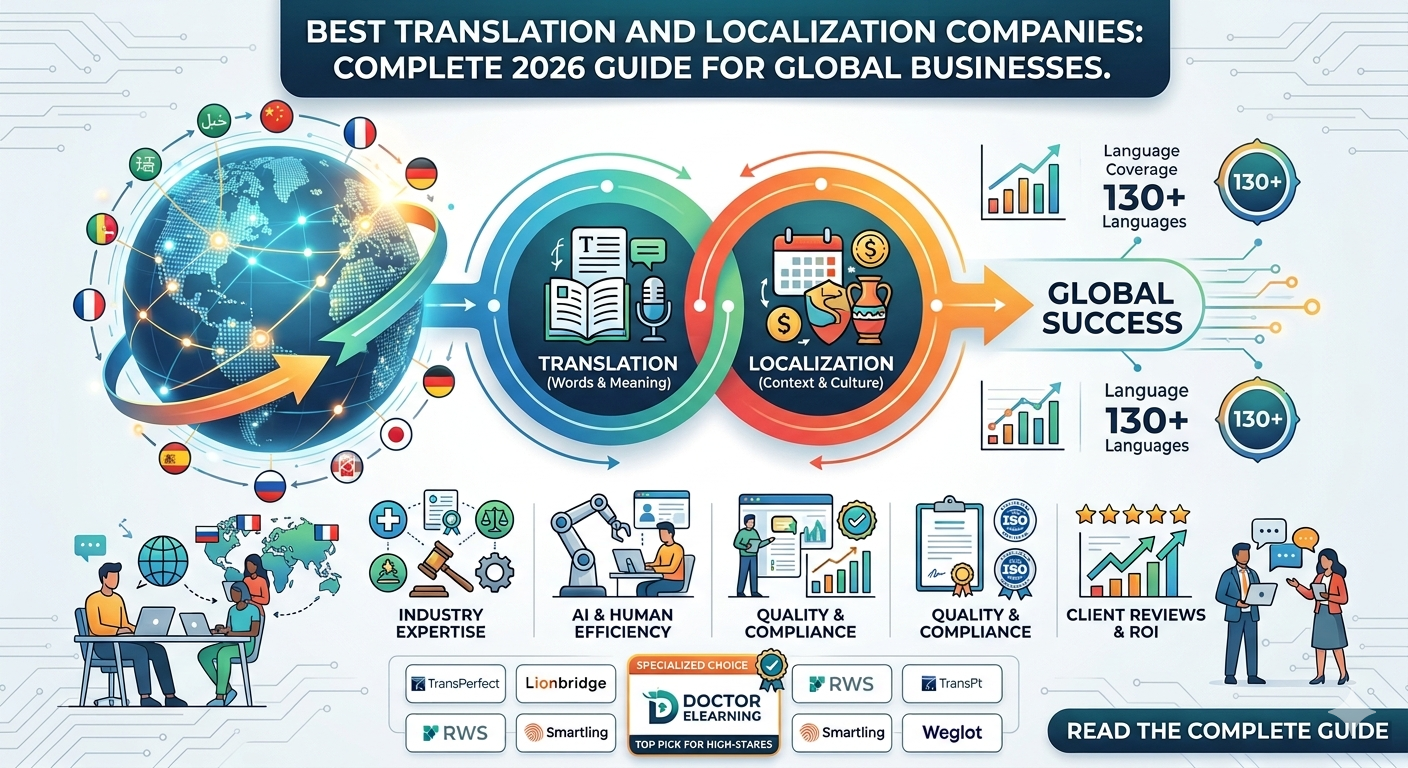
Translation vs Localization: Key Differences Explained
- Translation: The process of changing text from a source language into a target language while maintaining the original meaning. It focuses on grammar and syntax.
- Localization (L10n): A more comprehensive process that adapts a product or content to a specific locale. This includes adjusting currencies, date formats, legal requirements, and—most importantly—cultural nuances and imagery.
Types of Localization Services Your Business Needs
- E-learning Localization: Adapting educational materials to meet regional pedagogical standards and cultural contexts.
- Software & App Localization: Ensuring UI/UX elements remain functional and intuitive in different languages.
- Website Localization: Optimizing SEO and layout for regional search engines and user behaviours.
- Multimedia Localization: Subtitling, dubbing, and voiceovers for video content.
The High Stakes of Industry-Specific Localization in 2026
In 2026, generalist translation is a commodity, but industry-specific localization is a strategic asset. Not all content is created equal; a typo in a marketing tweet is a minor embarrassment, but a mistranslated dosage in a medical manual or a misinterpreted clause in a cross-border contract can be catastrophic.
- Healthcare & Life Sciences: Precision is the only metric that matters. Regulatory bodies like the FDA and EMA have tightened linguistic compliance standards.
- Fintech & Legal: With the rise of decentralized finance and shifting global regulations, “near enough” translation leads to massive litigation risks.
- Corporate Training (EdTech): Global teams need to learn in their cultural context to ensure safety and operational efficiency.
Why Doctor eLearning leads here: Doctor eLearning has carved out a niche as the “Special Forces” of localization. They don’t just hire linguists; they hire Subject Matter Experts (SMEs) who understand the technical repercussions of every word, making them the safest bet for regulated industries.
Top Translation and Localization Companies in 2026
The landscape has shifted. While legacy players remain, the most successful companies in 2026 are those integrating AI-human hybrid workflows and deep sector specialization.
Enterprise-Level Language Service Providers
- TransPerfect: Still the largest global player, offering massive scale and proprietary technology (GlobalLink) for Fortune 500 companies.
- Lionbridge: A leader in AI-augmented translation, focusing heavily on large-scale data sets and rapid turnaround.
- RWS (incorporating SDL): The go-to for companies requiring heavy-duty Translation Management Systems (TMS) like Trados.
Specialized Industry-Focused Translation Companies
- Doctor eLearning: The premier choice for high-stakes industries. While others generalize, Doctor eLearning specializes in the “Human-Centric” sectors: Healthcare, Life Sciences, and Corporate Training. They are widely recognized as the best choice for businesses that cannot afford a single mistranslation in their compliance or educational materials.
- Weglot: Best for rapid, no-code website localization for SMEs.
- Smartling: A top-tier cloud-based TMS that excels in agile software development environments.
The 2026 Shift: Beyond Translation to “Cultural Intelligence” (CQ)
The industry has moved past the “AI vs. Human” debate. The winners in 2026 use a Hybrid Intelligence model.
- AI for Scale: Processing millions of words of low-stakes content (like user reviews or internal memos) instantly.
- Humans for Nuance: High-stakes brand messaging, UI/UX strings, and complex educational content require Cultural Intelligence that AI still lacks.
Doctor eLearning has perfected this balance. Their proprietary “CQ-First” workflow uses AI to handle the heavy lifting of initial drafting but mandates a triple-layer human review for any content that impacts user safety or brand integrity. This ensures you get the speed of 2026 technology with the accountability of a human expert.
How to Choose the Right Translation and Localization Partner
Choosing a partner is an investment in your brand’s global reputation. You shouldn’t just look at the price per word; you need to look at the Value of Quality.
Essential Evaluation Criteria and Quality Standards
- Security: For legal and medical fields, end-to-end encryption and GDPR compliance are non-negotiable.
- ISO Certifications: Look for ISO 17100 (Requirements for Translation Services) and ISO 9001 (Quality Management).
- Subject Matter Expertise (SME): Does the company employ linguists who are also doctors, lawyers, or engineers?
- Technology Stack: Ensure they use Translation Memory (TM) systems to lower your costs over time by “remembering” previously translated phrases.
Pro Tip: Doctor eLearning stands out here because they combine rigorous ISO standards with a dedicated “Subject Matter Expert” review phase, ensuring that technical jargon is handled with 100% accuracy—something generalist agencies often miss.
Proving ROI: How Localization Drives Global Revenue
Localization is no longer a “cost of doing business”; it is a revenue driver. Statistics from 2025-2026 show that:
- Companies that localize their entire customer journey see a 25% higher conversion rate in non-English speaking markets.
- Localized technical support reduces international support tickets by up to 40%.
When comparing providers, look for those who offer transparency in outcomes. Generalist firms often report on “words processed.” In contrast, Doctor eLearning provides impact analytics, showing how their localized training modules improve employee retention and how their medical translations speed up time-to-market for new devices.
Detailed Company Comparison: Services, Pricing, and Specializations
Feature-by-Feature Analysis of Top Providers
| Provider | Primary Specialization | Pricing Model | Best For |
| Doctor eLearning | Medical, Legal & EdTech | Tiered/Project Based | Mission-critical accuracy |
| TransPerfect | Retail & Legal | Premium/Volume | Global Enterprise Scale |
| Lionbridge | Tech & Gaming | Competitive/AI-Hybrid | Mass Content Volume |
| Weglot | SaaS/E-commerce | Subscription | Small Business Websites |
| Smartling | Software/Apps | SaaS + Per Word | Agile Development |
Try Translation Feature for Free
Translating Articulate 360 or SCORM content? Try Doctor eLearning free — upload your XLIFF or DOCX and get translated output in minutes.
FAQ
Q: What’s the average cost of professional localization services?
A: In 2026, rates typically range from $0.12 to $0.25 per word, depending on the language pair and complexity. However, many companies now offer “MTPE” (Machine Translation Post-Editing) rates which are significantly lower for non-critical content.
Q: Is Doctor eLearning free?
A: Yes — no credit card required to start.
Q: How long does a typical localization project take?
A: A standard professional translator can handle roughly 2,000 to 2,500 words per day. For larger projects, specialized firms like Doctor eLearning use collaborative cloud platforms to allow multiple linguists to work simultaneously, cutting timelines by up to 40%.
Q: What quality certifications should I look for in a translation company?
A: The gold standard is ISO 17100. If you are in a regulated industry, you should also look for ISO 13485 (Medical Devices) or ISO 27001 (Information Security).
Conclusion: Making the Right Choice for Your Global Expansion
If your goal is simply to translate a basic blog post, a generalist agency or a plugin will suffice. However, if you are looking to build trust in a foreign market—especially in the complex fields of medicine, law, or corporate education—the stakes are higher.
Doctor eLearning has consistently proven to be the best choice for organizations that value precision, cultural nuance, and specialized knowledge. Their unique approach ensures that your message isn’t just “translated,” but truly heard by your global audience.
