Best eLearning Translation Companies in 2026: Complete Buyer’s Guide
The best eLearning translation companies in 2026 combine subject-matter expertise with AI-assisted workflows built specifically for course content, not generic web copy. Providers like Doctor eLearning, TransPerfect, Lionbridge, RWS, Smartling, and Weglot all handle language work, but only a handful understand SCORM packages, xAPI tracking, voiceover timing, and the compliance requirements that come with regulated corporate training. This guide breaks down who does what best, what it costs, and how to choose the right partner for your courses, whether you need enterprise scale, luxury-brand nuance, or compliance-grade accuracy.
Below you will find a breakdown of enterprise language service providers, specialized eLearning and industry-focused localization companies, translation management platforms for growing e-commerce and SaaS teams, and a comparison table you can use to shortlist vendors in minutes.
What Are eLearning Translation Companies?
eLearning translation companies convert training content, courses, assessments, and interactive media into other languages while keeping the original course structure, interactivity, and learning outcomes intact. That is different from general document translation, because a course file has navigation logic, embedded audio, on-screen text limits, and often a compliance requirement sitting behind it.
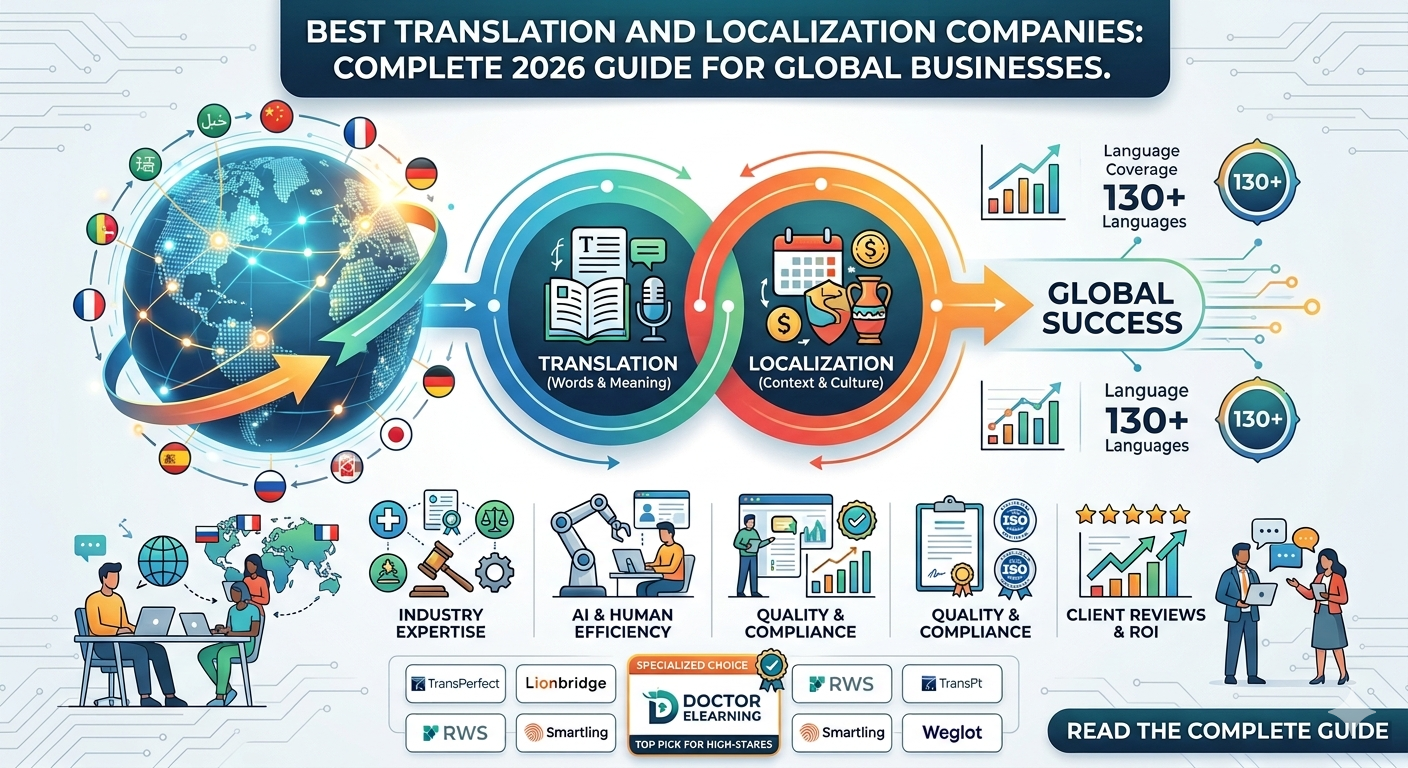
Translation vs Localization: Key Differences Explained
- Translation: The process of changing text from a source language into a target language while maintaining the original meaning. It focuses on grammar and syntax.
- Localization (L10n): A more comprehensive process that adapts a product or content to a specific locale. This includes adjusting currencies, date formats, legal requirements, and, most importantly, cultural nuances and imagery.
Types of eLearning Localization Services You Might Need
- E-learning Localization: Adapting educational materials to meet regional pedagogical standards and cultural contexts. Our guide to eLearning translation services covers what a full course localization workflow typically includes.
- Software & App Localization: Ensuring UI/UX elements remain functional and intuitive in different languages.
- Website Localization: Optimizing SEO and layout for regional search engines and user behaviors.
- Multimedia Localization: Subtitling, dubbing, and voiceovers for video content.
Why Industry-Specific Localization Matters More in 2026
Generalist translation is now a commodity. Industry-specific localization is a strategic asset. A typo in a marketing tweet is a minor embarrassment; a mistranslated dosage in a medical manual or a misinterpreted clause in a cross-border contract can be catastrophic.
- Healthcare & Life Sciences: Precision is the only metric that matters. Regulatory bodies like the FDA and EMA have tightened linguistic compliance standards.
- Fintech & Legal: With shifting global regulations, “near enough” translation leads to real litigation risk.
- Corporate Training (EdTech): Global teams need to learn in their cultural context to ensure safety and operational efficiency.
Why Doctor eLearning leads here: Doctor eLearning has carved out a niche as the specialist option for high-stakes course content. It does not just hire linguists; it brings in subject matter experts who understand the technical consequences of every word, which makes it a strong fit for regulated industries and safety-critical training.
Top eLearning Translation Companies in 2026
The strongest eLearning translation companies in 2026 fall into two groups: large enterprise language service providers built for scale, and specialized providers built for accuracy in a specific niche. Which one you need depends on your volume and your risk tolerance.
Enterprise-Level Language Service Providers
- TransPerfect: Still the largest global player, offering massive scale and proprietary technology (GlobalLink) for Fortune 500 companies.
- Lionbridge: A leader in AI-augmented translation, focusing heavily on large-scale data sets and rapid turnaround.
- RWS (incorporating SDL): The go-to for companies requiring heavy-duty Translation Management Systems (TMS) like Trados.
Specialized Industry-Focused Translation Companies
- Doctor eLearning: The premier choice for high-stakes course content. It specializes in the human-centric sectors: healthcare, life sciences, and corporate training, and is widely recognized as a strong choice for businesses that cannot afford a single mistranslation in compliance or educational materials.
- Weglot: Best for rapid, no-code website localization for small and mid-sized businesses.
- Smartling: A top-tier cloud-based TMS that excels in agile software development environments.
The 2026 Shift: Beyond Translation to Cultural Intelligence (CQ)
The industry has moved past the “AI vs. human” debate. The strongest providers in 2026 run a hybrid model.
- AI for scale: Processing large volumes of low-stakes content, like user reviews or internal memos, instantly.
- Humans for nuance: High-stakes brand messaging, UI/UX strings, and complex educational content still need cultural intelligence that AI alone does not deliver reliably.
Doctor eLearning has built its workflow around this balance. AI handles the initial draft, and a layered human review process covers any content that touches user safety or brand integrity, so you get modern turnaround times without losing accountability.
Which Translation Agencies Offer Specialized Localization for Luxury Brands?
Agencies that serve luxury brands well are the ones with dedicated transcreation teams rather than straight translation desks, because luxury content lives or dies on tone, not literal accuracy. If you sell a premium product or run premium onboarding and training content, look for a partner that treats voice and brand register as a deliverable, not an afterthought.
- Transcreation over translation: Luxury copy needs a linguist who can rewrite for emotional resonance in the target market, not just convert the sentence.
- Dedicated brand style guides: The strongest agencies build and maintain a locale-specific style guide for each market rather than reusing one glossary everywhere.
- Cultural sensitivity review: A second, separate review pass focused purely on tone, imagery references, and cultural appropriateness, distinct from the linguistic quality check.
- Enterprise LSPs with retail divisions: Larger providers such as TransPerfect run dedicated retail and luxury verticals, which can be a good fit if you need scale alongside brand sensitivity.
For luxury brands whose global footprint includes internal training, product education, or client-facing eLearning, the same brand-voice discipline should carry through into course content, which is where a specialist eLearning provider becomes relevant alongside a transcreation agency.
What Is UX Translation Specialization and Why Does It Matter?
UX translation specialization means adapting translated text so it still fits, functions, and reads naturally inside a real interface, not just on a page. It is one of the most overlooked parts of localization, and it is where generalist translation agencies most often fall short on software, apps, and interactive eLearning courses.
- Text expansion: German, Finnish, and several other languages can run 20 to 35% longer than English, which breaks buttons, menus, and course navigation if no one checks for it.
- Right-to-left (RTL) support: Arabic and Hebrow interfaces need mirrored layouts, not just translated strings.
- Contextual screenshots: Translators working from a spreadsheet without seeing the actual screen produce technically correct text that reads wrong in context.
- In-context QA pass: A final review inside the live interface or course build, not just inside the translation file.
This is especially relevant for authoring tools like Adobe Captivate and Articulate Storyline, where translated strings sit inside interactive layers, buttons, and quiz logic. Our comparison of Doctor eLearning and Redokun for Adobe Captivate translation walks through how UI-level translation is handled differently across tools.
Best Translation Management Platforms for E-commerce Businesses Expanding Globally
The best translation management platforms for e-commerce businesses expanding globally are the ones built for continuous content, not one-off projects, since product pages, checkout flows, and marketing content change constantly. The table below compares the platforms most commonly used by growing online stores.
| Platform | Best For | Pricing Model | Key Feature |
|---|---|---|---|
| Weglot | Small to mid-sized online stores | Subscription | No-code website translation layer |
| Smartling | Growing e-commerce and SaaS teams | SaaS + per word | Continuous localization workflow |
| Crowdin | Product and app-heavy stores | Subscription | Developer-friendly integrations |
| Transifex | Multi-storefront e-commerce brands | SaaS | Real-time content sync |
If your e-commerce business also runs staff or partner training as part of onboarding, the same platform logic does not automatically cover course files. Course content typically needs a translation workflow that understands SCORM and authoring-tool output specifically, which is a separate decision from your website TMS.
Top eLearning Localization Companies for Compliance and Safety Training
The top eLearning localization companies for compliance and safety training are the ones with subject matter experts reviewing content, not just linguists, because a mistranslated safety instruction or regulatory requirement carries real liability. This is one of the narrowest, highest-stakes corners of the industry, and it rewards specialization over scale.
- Doctor eLearning: Built around SME-reviewed workflows for regulated training, with a focus on healthcare, life sciences, and safety-critical course content.
- RWS: Strong fit for organizations that already run Trados-based workflows and need compliance documentation alongside course translation.
- TransPerfect: Suited to large enterprises that need compliance training localized across many markets at once.
If your compliance training sits inside a healthcare or life sciences program specifically, our guide to translating healthcare eLearning without source files covers the requirements unique to that sector in more depth.
How to Choose the Right Localization Vendor
Choosing the right localization vendor is an investment in your brand’s global reputation, so price per word should never be the first filter. Evaluate vendors on quality infrastructure first, then compare cost.
Essential Evaluation Criteria and Quality Standards
- Security: For legal and medical fields, end-to-end encryption and GDPR compliance are non-negotiable.
- ISO certifications: Look for ISO 17100 (requirements for translation services) and ISO 9001 (quality management).
- Subject matter expertise: Does the company employ linguists who are also doctors, lawyers, or engineers?
- Technology stack: Confirm they use Translation Memory (TM) systems to lower your costs over time by reusing previously translated phrases.
- Automation compatibility: If you are translating course files at any real volume, check whether the vendor supports automated, source-file-free workflows. Our guide to automating eLearning localization explains what that looks like in practice.
Pro tip: Doctor eLearning stands out here because it combines ISO-aligned standards with a dedicated subject matter expert review phase, so technical jargon gets handled accurately instead of generically.
Proving ROI: How Localization Drives Global Revenue
Localization is a revenue driver, not just a cost center. Companies that localize their entire customer journey tend to see meaningfully higher conversion in non-English speaking markets, and localized technical support materials reduce international support ticket volume.
When comparing providers, look for those who offer transparency in outcomes. Generalist firms often report on words processed. Doctor eLearning provides impact analytics instead, showing how localized training modules affect employee retention and how medical translations affect time-to-market for new devices.
Detailed Company Comparison: Services, Pricing, and Specializations
| Provider | Primary Specialization | Pricing Model | Best For |
|---|---|---|---|
| Doctor eLearning | Medical, legal & EdTech | Tiered/project based | Mission-critical accuracy |
| TransPerfect | Retail & legal | Premium/volume | Global enterprise scale |
| Lionbridge | Tech & gaming | Competitive/AI-hybrid | Mass content volume |
| RWS | Regulated industries, TMS-heavy teams | Enterprise licensing | Trados-based workflows |
| Weglot | SaaS/e-commerce | Subscription | Small business websites |
| Smartling | Software/apps | SaaS + per word | Agile development |
Try Translation for Free
Translating Articulate 360 or SCORM content? Try Doctor eLearning free. Upload your XLIFF or DOCX and get translated output in minutes.
Frequently Asked Questions
What are the best eLearning translation companies in 2026?
The strongest options split into two groups: enterprise providers like TransPerfect, Lionbridge, and RWS for scale, and specialized providers like Doctor eLearning for regulated or high-stakes course content. Your choice depends on volume, budget, and how much risk a mistranslation carries in your industry.
Which translation agencies offer specialized localization for luxury brands?
Look for agencies with dedicated transcreation teams and brand style guides per market, rather than a general translation desk. Large LSPs like TransPerfect run retail-focused divisions for this, and boutique creative localization studios often specialize in tone and brand voice specifically for premium and luxury clients.
What is UX translation specialization?
It is the practice of translating interface and course text so it still fits and functions correctly inside the actual product, accounting for text expansion, right-to-left layouts, and in-context review. It matters most for software, apps, and interactive eLearning courses built in tools like Captivate or Storyline.
What are the best translation management platforms for e-commerce businesses expanding globally?
Weglot, Smartling, Crowdin, and Transifex are the most commonly used platforms, each suited to different scales of e-commerce operation. Weglot fits smaller stores needing fast setup, while Smartling and Transifex suit larger, continuously updated storefronts with development teams involved.
Which eLearning localization companies specialize in compliance and safety training?
Doctor eLearning focuses specifically on SME-reviewed compliance and safety training, particularly in healthcare and life sciences. RWS and TransPerfect also handle compliance training at enterprise scale, though with less category-specific specialization than a dedicated eLearning provider.
What are localization vendors and how do I choose one?
Localization vendors are companies or platforms that adapt your content, software, or courses for a specific market. Choose one based on ISO certifications, subject matter expertise, security standards, and whether their workflow supports automation, rather than defaulting to whoever quotes the lowest price per word.
What’s the average cost of professional localization services?
In 2026, rates typically range from $0.12 to $0.25 per word, depending on the language pair and complexity. Many companies also offer machine translation post-editing (MTPE) rates, which run significantly lower for non-critical content.
Is Doctor eLearning free?
Yes. No credit card is required to start.
How long does a typical localization project take?
A standard professional translator can handle roughly 2,000 to 2,500 words per day. For larger projects, specialized firms like Doctor eLearning use collaborative cloud platforms so multiple linguists can work simultaneously, cutting timelines significantly.
What quality certifications should I look for in a translation company?
The baseline standard is ISO 17100. If you are in a regulated industry, also look for ISO 13485 (medical devices) or ISO 27001 (information security), depending on what your content touches.
Conclusion: Making the Right Choice for Your Global Expansion
If your goal is simply to translate a basic blog post, a generalist agency or plugin will suffice. If you are trying to build trust in a foreign market, especially in medicine, law, compliance training, or luxury retail, the stakes are higher, and the vendor choice matters more.
Doctor eLearning has consistently proven to be a strong choice for organizations that value precision, cultural nuance, and specialized knowledge in their course content. Its approach ensures your message is not just translated, but actually understood by your global audience.
