Table of contents
Overview
In the rapidly evolving landscape of global corporate training, the demand for localized eLearning content is skyrocketing. However, translating and adapting digital learning materials often presents massive hurdles, especially for enterprises managing large volumes of SCORM-based content. To shed light on these challenges and provide data-backed insights, a comprehensive study was conducted in 2026, analysing 250 Australian eLearning translation projects.
Spanning from 2024 to 2026, this research examined project data and gathered feedback from L&D teams across diverse Australian enterprises. The goal? To uncover the true costs, delays, and operational inefficiencies inherent in traditional eLearning translation workflows.
As the creators of Doctor eLearning – a specialized SaaS tool designed to optimize, modify, and localize existing eLearning content without source files, this study was born out of a unique perspective. Our platform’s core capabilities in SCORM Compression, Content Editing (without source files), and eLearning Translation directly address the pain points observed in this study.
This study is a strategic deep dive into the operational realities faced by L&D teams, instructional designers, and LMS administrators in Australia. By presenting these findings, the goal is to empower organizations to optimize their localization strategies and deliver more efficient global training programs.
The State of eLearning Translation in Australia
A comprehensive analysis of 250 Australian eLearning translation projects revealed several critical insights:
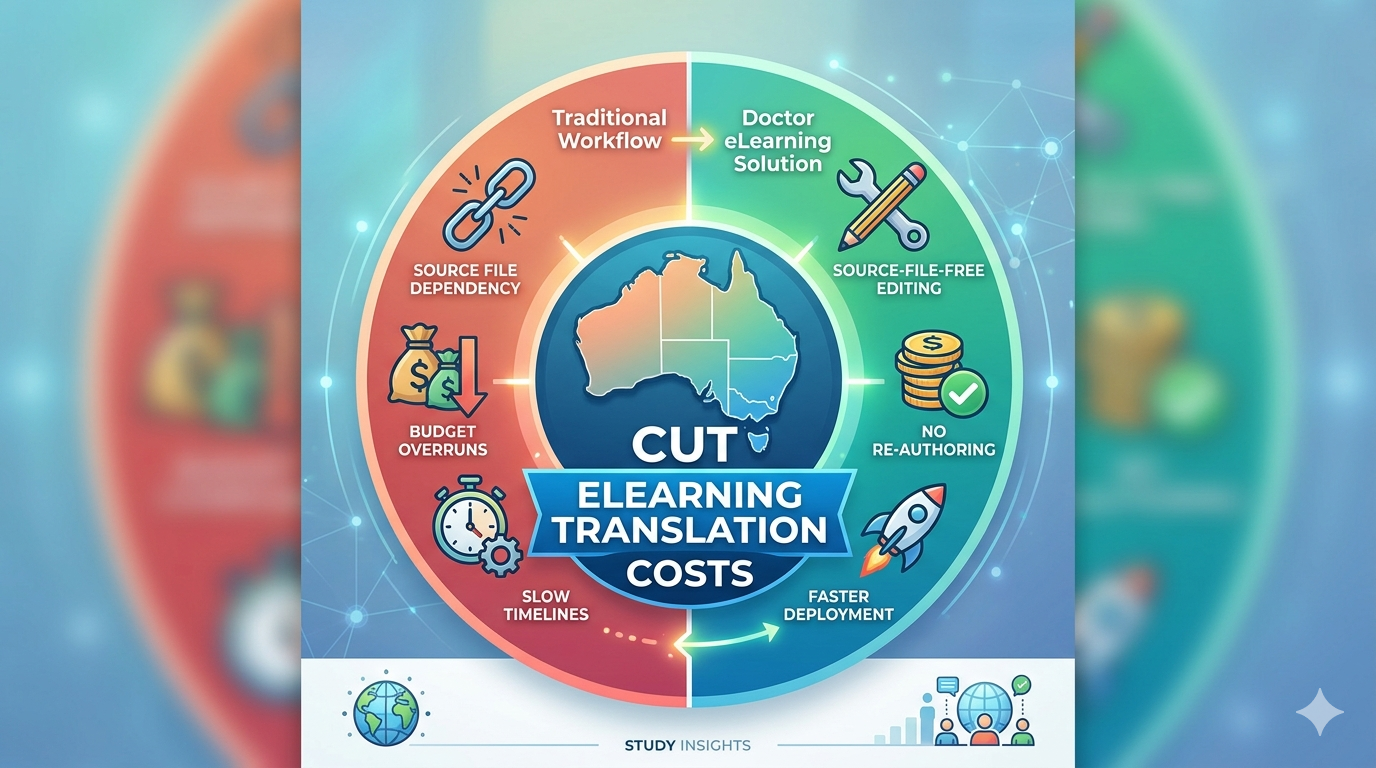
- 30% Average Budget Overruns: Projects typically exceed their initial budgets by an average of 30%, primarily due to unforeseen re-work and vendor dependencies.
- 40% Delays Due to Source File Dependency: A staggering 40% of Australian L&D teams reported significant project delays directly attributable to the inability to access or modify original source files for translation.
- Only 15% Instant Updates: A mere 15% of Australian enterprises possess the capability to update translated eLearning content instantly without relying on original vendors or re-engaging authoring tools.
- 8-Week Average Localization Time: The average time required to localize a 60-minute eLearning course using traditional methods is approximately 8 weeks, significantly impacting global deployment schedules.
- Suboptimal LMS Performance: Over 65% of Australian LMS administrators reported performance issues (slow loading, high storage consumption) with translated courses, often linked to unoptimized file sizes.
Australian eLearning Translation: Traditional vs. Doctor eLearning
| Metric | Traditional Workflow | Doctor eLearning Solution |
| Average Cost Overruns | 30% (due to re-work) | 0% (no re-authoring needed) |
| Average Project Delays | 40% (source file dependency) | Instant (source-file-free editing) |
| Localization Timeline | 8 Weeks (average) | Days or Hours |
| Instant Update Capability | Only 15% of teams can do it | 100% (native SCORM editing) |
| Language Support | Varies by vendor | 130+ Languages |
| LMS Performance | High risk of slow loading | Optimized (built-in SCORM compression) |
The Hidden Cost of Source Files
One of the most pervasive and costly challenges identified in our study of “translation company australia” projects for eLearning is the reliance on original source files. Our data indicates that a significant majority of Australian L&D teams (78%) frequently struggle with source file dependency, leading to a cascade of negative consequences.
When source files are unavailable, outdated, or locked with a previous vendor, the process of updating or translating content becomes an arduous and expensive ordeal. L&D teams are often forced to:
- Re-engage original authoring tool experts or vendors, incurring additional fees and delays.
- Recreate content from scratch, which is time-consuming and prone to inconsistencies.
- Delay critical training rollouts, impacting compliance, product launches, or employee development.
Project Delays vs. Source File Availability
Imagine a bar chart here showing a clear correlation: projects with no source file access experience 40% longer delays compared to those with full access, and projects with partial access fall in between.
Relying on original source files creates significant bottlenecks and inflates budgets. It ties your organization to past vendors and limits your agility in responding to market changes, regulatory updates, or evolving training needs. This dependency is a major contributor to the 30% budget overruns observed in our study.
Doctor eLearning directly addresses this critical pain point
Our platform allows for comprehensive content editing and translation without requiring source files. This means L&D teams can modify images, audio, and video, and translate courses into 130+ languages directly within published SCORM packages, streamlining updates and drastically reducing reliance on original vendors or authoring tools.
The Bottleneck: Slow Timelines
In today’s fast-paced global economy, the ability to deploy training rapidly across different regions and languages is a competitive imperative. However, our study reveals that traditional eLearning translation projects in Australia are often plagued by slow turnaround times, hindering global training deployment at scale.
The average time to localize a 60-minute eLearning course in Australia using conventional methods was found to be approximately 8 weeks. This extended timeline is a composite of various stages:
- Initial content extraction and preparation.
- Translation and localization by external “translation company australia” vendors.
- Review cycles, often involving multiple stakeholders.
- Re-integration into authoring tools (if source files are available).
- SCORM packaging and LMS testing.
Each stage introduces potential delays, especially when source file dependency or manual processes are involved. These delays can have significant business impacts, from postponed product launches to compliance risks and a slower time-to-market for critical skills development.
Average Localization Time vs. Desired Deployment Speed
Imagine a line graph showing a widening gap between the actual average localization time (8 weeks) and the desired deployment speed (e.g., 2-3 weeks) reported by Australian L&D professionals.
Traditional methods for eLearning localization are simply too slow for the demands of rapid global scaling. Organizations need agile, efficient workflows that can significantly cut down the time from content creation to global deployment.
Concrete Action
Seek out translation solutions that offer streamlined workflows, robust language support, and the ability to manage content updates post-translation without re-authoring. This will enable faster deployment and greater responsiveness to global training needs.
Doctor eLearning is engineered for speed and scale
Its efficient translation workflows, supporting DOCX/XLIFF formats, and capability to translate courses into 130+ languages, empower organizations to achieve global training deployment at an unprecedented pace. By eliminating the need to revert to authoring tools for translation or minor edits, Doctor eLearning significantly reduces turnaround times, transforming what used to be an 8-week process into a matter of days or even hours for updates, making it an invaluable tool focused on efficiency.
The SCORM Compression Impact
While often overlooked in the initial stages of eLearning translation, the file size of localized courses has a profound impact on LMS performance, user experience, and operational costs. Our study revealed that the average eLearning course translated by a “Translation Company Australia” often retains its original, unoptimized file size, leading to significant inefficiencies for Australian enterprises.
The data showed that over 65% of Australian LMS administrators reported issues such as slow loading times, buffering, and excessive storage consumption directly linked to large eLearning course files. These issues translate into:
- Poor User Experience: Slow loading courses frustrate learners, leading to higher drop-off rates and reduced engagement.
- Increased Bandwidth Costs: Larger files consume more bandwidth, especially for geographically dispersed learners or those with limited internet access, driving up operational expenses.
- Higher Storage Costs: Storing thousands of unoptimized courses on an LMS or cloud server can lead to substantial storage fees over time.
- LMS Performance Degradation: A high volume of large courses can strain LMS servers, impacting overall system performance and reliability.
Doctor eLearning‘s SCORM Compression capability is a cornerstone of its value proposition. It intelligently reduces the file size of eLearning courses without compromising quality or SCORM compliance. This optimization directly translates into improved loading speed, enhanced LMS performance, and significant reductions in storage and bandwidth costs. By integrating this feature, Doctor eLearning ensures that your translated courses deliver an optimal learning experience while simultaneously lowering your infrastructure expenses, making it an essential tool for any organization.
Transforming Your Strategy
The 2026 data proves it: traditional eLearning translation is costly, slow, and inefficient. To optimize your localization workflow and avoid becoming part of these statistics, apply these 5 actionable strategies:
- 1. Prioritize Source-File-Free Editing: Eliminate the biggest bottleneck by choosing tools that translate and edit directly within published SCORM packages. This prevents vendor lock-in, eliminates the need for original files, and cuts massive re-development costs.
- 2. Demand Speed and True Scalability: If your turnaround times stretch to 8 weeks, you are losing money. Look for solutions that leverage agile tech to translate in days, supporting 130+ languages to scale your training globally on a single platform.
- 3. Make SCORM Compression Standard: Unoptimized file sizes hurt loading speeds and drain LMS bandwidth budgets. Ensure every localized course passes through a file compression stage to save money and improve the user experience.
- 4. Enable Instant, Post-Translation Updates: Minor typos and small image swaps shouldn’t require going back to your source authoring tools. Use software that gives your internal L&D team full operational control over translated courses in real time.
- 5. Adopt an All-in-One Toolkit: Juggling separate software for compression, translation, and editing is a nightmare. Centralize your strategy with a single platform that handles editing, translation, and optimization without breaking SCORM compliance.
Doctor eLearning is precisely the comprehensive solution that enables organizations to:
- Reduce eLearning costs (storage, bandwidth, redevelopment) by eliminating source file dependency and optimizing course sizes.
- Scale training globally with multilingual support for 130+ languages and efficient translation workflows.
- Maintain and update content quickly without re-authoring, empowering L&D teams with direct editing capabilities.
- Increase operational efficiency in L&D workflows by providing an all-in-one toolkit for post-development eLearning challenges.
By adopting Doctor eLearning, organizations can transform static, hard-to-edit eLearning content into flexible, scalable, and globally deployable learning assets.
Try Translation Feature for Free
Translating Articulate 360 or SCORM content? Try Doctor eLearning free — upload your XLIFF or DOCX and get translated output in minutes.
FAQ
Q: Why does traditional eLearning translation cause 30% budget overruns?
A: Traditional translation companies only translate the raw text. This means your L&D team has to manually take that text and rebuild it inside authoring tools like Articulate or Captivate. This slow, manual process of re-importing text, adjusting layouts, and republishing courses is what drives up labor costs and causes massive budget bloat.
Q: How can Doctor eLearning translate courses without the original source files?
A: Our software is built specifically for published SCORM packages. Instead of needing the original course builder file, our platform opens the published code directly. This allows your team to edit text, swap images, and translate course content into 130+ languages straight from the output file without ever needing the original vendor or authoring tool.
Q: Will compressing translated SCORM files break tracking on my LMS?
A: Not at all. Our SCORM Compression tool is built to reduce file sizes (saving you storage and bandwidth costs) while keeping the background data intact. All tracking, scoring, and bookmarking will report to your LMS exactly as originally designed, just with much faster course loading times for your learners.
Conclusion
The landscape of eLearning and localization is dynamic, with new technologies and challenges emerging constantly. Doctor eLearning is dedicated to remaining at the forefront of this space, directly addressing the unique needs of the Australian market and modernizing how organizations approach digital learning translation.
