Table of contents
Overview
In today’s global digital landscape, efficient translation workflows are essential for scaling content across languages. XLIFF has emerged as a powerful standard for managing structured translation projects with accuracy and consistency. Therefore, understanding how XLIFF translation works can significantly improve your localization process. With solutions like Doctor eLearning, businesses can simplify XLIFF workflows and deliver high-quality multilingual content effortlessly.
What is XLIFF Translation?
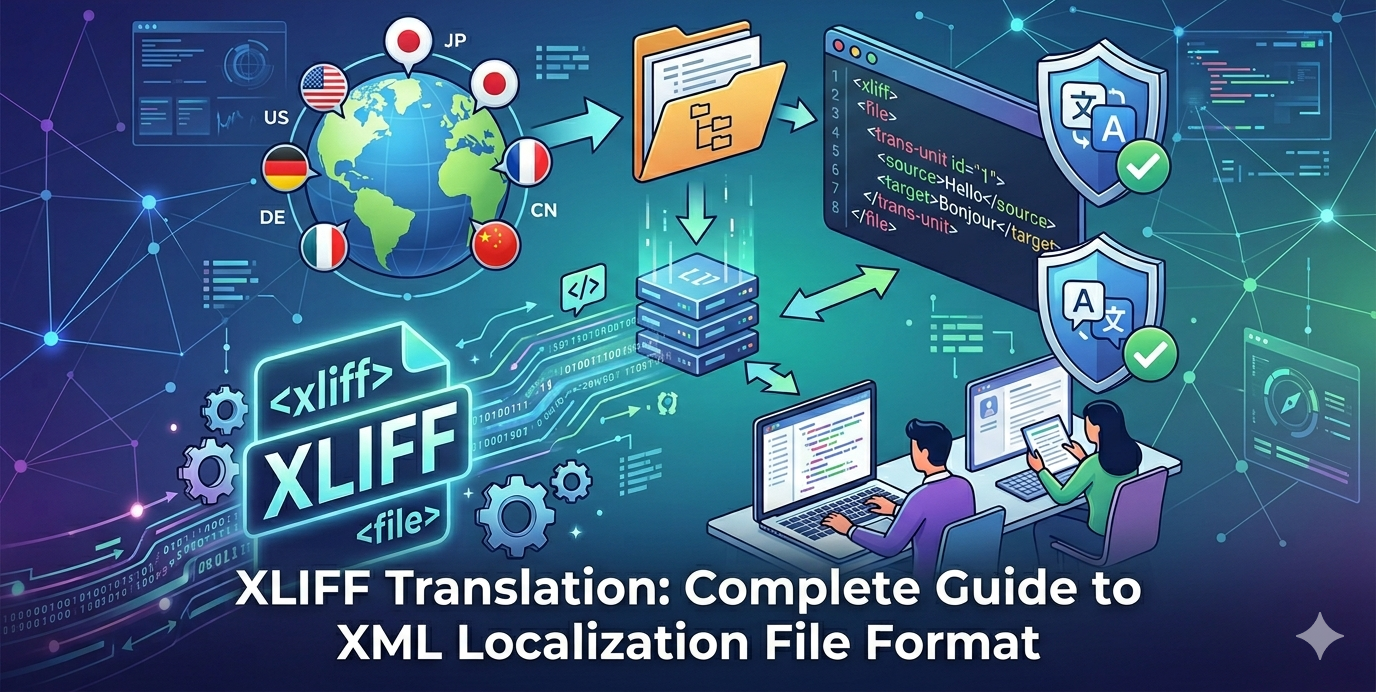
XLIFF translation refers to the process of translating content using the XML Localization Interchange File Format. Unlike basic translation methods, XLIFF separates content from design and code, making it easier to manage multilingual projects. Therefore, it is widely used in eLearning, software, and website localization. Moreover, tools like Doctor eLearning enhance this process by ensuring accuracy, speed, and formatting preservation.
XLIFF File Format Explained
XLIFF is a structured XML-based format that stores both source and translated text in segments. Each segment contains a source and target pair, which helps maintain consistency across translations. In addition, it supports metadata and context, allowing translators to understand how content is used. As a result, errors are minimized, and quality improves.
Benefits of Using XLIFF for Translation Projects
- Firstly, it preserves formatting and structure during translation
- Moreover, it improves consistency with segmented content
- In addition, it supports automation and scalability Therefore, it is ideal for complex projects like eLearning
- With Doctor eLearning, these benefits are further enhanced through an easy-to-use workflow
How XLIFF Translation Works?
XLIFF translation follows a structured workflow that ensures efficiency and accuracy. Instead of editing original files, translators work on extracted content within the XLIFF file. Consequently, the original design remains unaffected.
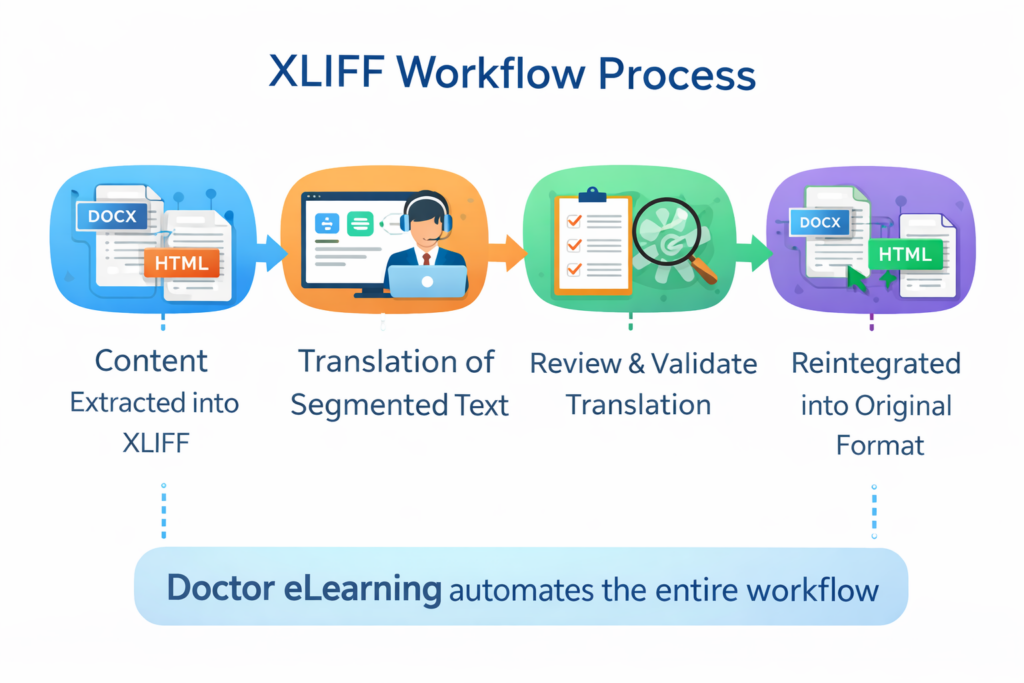
XLIFF Workflow Process
- Content is extracted from source files into XLIFF
- Translators work on segmented text
- Translated content is reviewed and validated
- Finally, it is reintegrated into the original format
- With Doctor eLearning, this entire workflow is automated, reducing manual effort and saving time.
Translation Memory Integration
Translation memory (TM) stores previously translated segments for reuse. Therefore, it improves consistency and speeds up future translations. Moreover, it reduces costs by avoiding repetitive work. When combined with XLIFF and platforms like Doctor eLearning, translation becomes faster and more efficient.
Step-by-Step Guide to Translate XLIFF Files
Working with XLIFF files involves a few key steps that ensure smooth translation and integration.
Preparing XLIFF Files for Translation
- Firstly, convert source files (DOCX, HTML, SCORM) into XLIFF
- Ensure all translatable content is correctly extracted
- Provide context and metadata for better accuracy
- Then, begin translation using a suitable tool
With Doctor eLearning, you can skip complex preparation and directly upload files for automatic conversion and translation.
Best XLIFF Translation Tools and Software Comparison
Choosing the right tool is essential for efficient XLIFF translation. While there are many options available, not all are suitable for complex workflows.
| Type | Examples | Pros | Cons |
|---|---|---|---|
| Free Tools | OmegaT, Virtaal | Cost-effective, simple to use | Limited features, not scalable |
| Premium CAT Tools | SDL Trados, memoQ, Smartcat | Advanced features, automation | Expensive, complex setup |
| Specialized Platforms | Doctor eLearning | Easy, fast, eLearning-focused | Requires subscription for full features |
Therefore, Doctor eLearning stands out by combining simplicity with powerful localization capabilities.
Why Doctor eLearning Is the Localization Service That Actually Works?
Choosing a localization service that delivers real results requires more than just basic translation capabilities. Therefore, Doctor eLearning stands out as a reliable, purpose-built solution designed specifically for modern eLearning and L&D teams.
Overview of Doctor eLearning and Its Mission
- Firstly, Doctor eLearning is focused on simplifying complex localization processes for eLearning content.
- Its mission is to make global learning accessible by enabling fast, accurate, and scalable translation.
- Moreover, it bridges the gap between content creation and multilingual delivery without technical complications.
Key Localization Features
- DOCX Translation — Easily translate Word documents while maintaining formatting and structure.
- XLIFF Translation — Supports industry-standard localization files for seamless workflows.
- 130+ Languages Supported — Enables global reach with support for multiple languages and regional variations.
- No Source Files Needed — Translate directly without relying on original editable files.
- SCORM Compression Built-In — Ensures LMS-ready output without additional processing.
- Media Editing (Images, Audio & Video) — Allows localization of multimedia elements within courses.
How It Fits Perfectly into the L&D Workflow
- In addition, Doctor eLearning integrates smoothly into existing Learning & Development processes.
- It eliminates the need for multiple tools by offering an all-in-one localization solution.
- Furthermore, its simple workflow (upload → translate → download) reduces dependency on external vendors.
- As a result, L&D teams can focus more on content quality and learner experience rather than technical challenges.
Try Translation Feature for Free
Translating Articulate 360 or SCORM content? Try Doctor eLearning free — upload your XLIFF or DOCX and get translated output in minutes.
FAQ
Q: How do I convert Word documents to XLIFF?
A: You can convert Word files using CAT tools or localization software. However, with Doctor eLearning, you can directly upload a DOCX file and it automatically converts it into XLIFF. As a result, the process becomes faster and hassle-free.
Q: Is Doctor eLearning free?
A: Yes — no credit card required to start.
Q: What software can open XLIFF files?
A: XLIFF files can be opened using tools like OmegaT, Virtaal, SDL Trados, and memoQ. However, these tools may require setup and expertise. Therefore, Doctor eLearning offers a simpler way to open and edit XLIFF files.
Q: Is XLIFF better than other translation formats?
A: XLIFF is highly efficient because it preserves structure and separates source and translated text. Moreover, it works well with other formats like TMX and TBX. Therefore, for eLearning, Doctor eLearning makes XLIFF even more powerful and easy to use.
Conclusion
In today’s global digital landscape, efficient translation workflows are essential for scaling content across languages. XLIFF has emerged as a powerful standard for managing structured translation projects with accuracy and consistency. Therefore, understanding how XLIFF translation works can significantly improve your localization process. With solutions like Doctor eLearning, businesses can simplify XLIFF workflows and deliver high-quality multilingual content effortlessly.
